

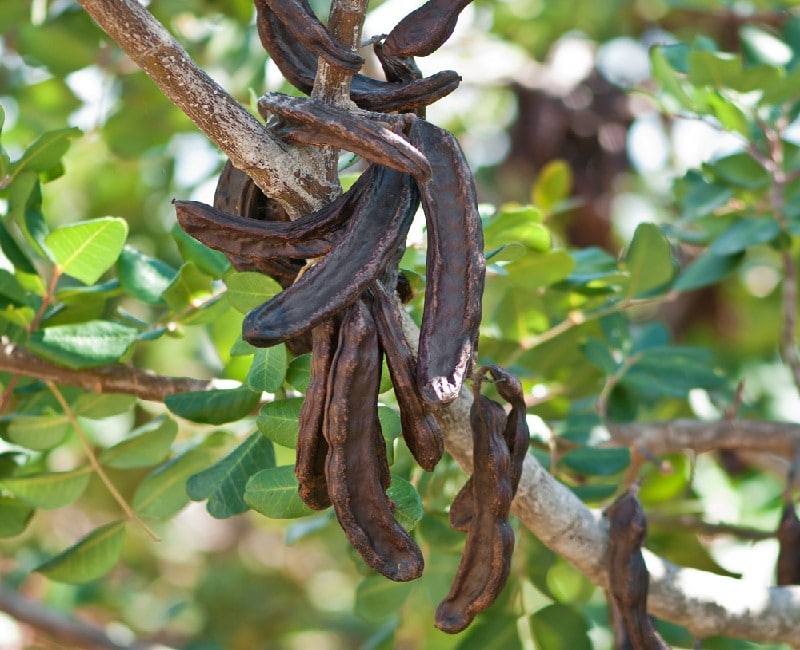
Carob : Carob (word coming from Arabic qirat, “small weight”) is the podded fruit of the carob tree. This tree has the particularity of giving flowers and fruit at the same time, which makes it possible to predict the following year's harvest. Being part of legumes, it appreciates dry or rocky arid soils. It is a healthy and organic tree because it grows without fertilizers, chemical additives and pesticides.
The carob tree is a tree dioecious (whose individuals carry only one type of gamete, male or female), of the family Fabaceae (Botanical name: Ceratonia siliqua) evergreen, native to Mediterranean regions (Canary Islands, North Africa, Near East, Southern Europe). This thermophilic species has been widely cultivated and thrives on arid slopes. It is cultivated for its fruit, carob.
The fruit is also called: fruit of Judas tree, silique, Carouge, Bread of Saint John the Baptist (this saint would have survived in the desert by having consumed carobs), Egyptian fig tree, Pythagorean bean.
The carob is a pod which can reach 30 cm long, thick containing a sweet pulp, nutritious, refreshing and as rich in sugar as the treacle, to taste chocolatey.
The carob tree is cultivated in Mediterranean countries, particularly in Spain and southern Italy (Sicily). Morocco is the second largest producer of carobs in the world. The Zayan Berbers use it for its medicinal virtues because, thanks to its high fiber content, it has a regulating effect on intestinal function. It is then administered in the form of an instant preparation, like hot chocolate.
In Cyprus, carob is transformed into a kind of confectionery, appreciated as candy local. Manufacturing begins with the grinding of the seeds, extraction with water then hot concentration for several days; The concentrated syrup is crocheted. The end result is close to the texture of barley sugar but with a much darker color.
Two very different products are obtained from the carob tree, used extensively by the food industry: carob flour and carob gum.
Locust bean gum comes from the thin brown husk that covers the seeds. It contains a endosperm white and translucent which acts as a thickener.
History: As early as the 13th century, carob seeds, which all have the same weight, were used as a unit of measurement to weigh gold and precious stones. Indeed, whatever the size of their pod
seeds of carob always have the same weight. One carob seed corresponds to one carat. Moreover, the etymology of the word “carat” comes from the Italian carat, borrowed from Arabic qirat “small weight” and “carob seed”.
Arabic is itself borrowed from Greek keration “little horn” and “carob” because of the shape of the fruit.
– Human food: if the direct consumption of carobs has only an anecdotal value, carob flour is used today in the food industry as food additive (code E410) for refreshing ice
pâtisseries
foodstuffs diet (there is no gluten in carob), like thickening and in particular as substitute de cocoa. Carob, unlike its counterpart cocoa, does not contain theobromine, neither caffeineTwo alkaloids to the exciting action on the body, but it is rich in protein and twice as rich in calcium.
Note, however, that Guy Martin, private and owner of Le Grand Véfour restaurant in Paris (1st arrondissement), does not hesitate to use whole dried carobs in its recipes. as the Soupe au chocolate.
In Tunisia, it is used as a basis for drinks sparkling called Boga and cider El-Meddeb.
In Lebanon it is boiled and its concentrate gives a treacle Nature fresh and creamy (debs kharoube). Mixed withSesame oil (tahini) it is eaten with Lebanese bread (referee).
In Crete, we make it syrup (with the broken), of the all-purpose flour to make biscuits traditional and Team cakes which we offer to the whole family.
– Infant nutrition: all-purpose flour carob is used in lait en poudre for baby like thickening replacing the traditional wheat flour. This type of treatment is recommended to combat childhood gastroesophageal reflux. This carob flour is supposed to be less allergenic than all-purpose flour de cereals.
– Animal feed: carobs are an excellent energy feed for livestock. They are sometimes incorporated into compound foods.
– Ornamental tree with its foliage, which provides shade appreciated in sunny countries.
The seeds of the carob tree make it possible to produce a gum used mainly in the food industry, but also in other industrial applications (paper industry, textiles, pharmacy, cosmetics, etc.).
– Poetry: There are many references to this fruit in traditional Arabic literature (Rouba'i-iatu Al-Khayyam: poem by Ahmad Rami dedicated to carob).
– Bible: Carobs or blackbirds or pods according to translations are mentioned in the Gospel according to Luke in the parable of the Prodigal Son (chapter 15, verse 16). The latter having squandered all the fortune given by his father “would have liked to fill his belly with the carobs that the people ate. pigs, but no one gave him any.”
See as well Carob under Mouth slang.
Buy your locust bean powder and gum here at the best price on the market: