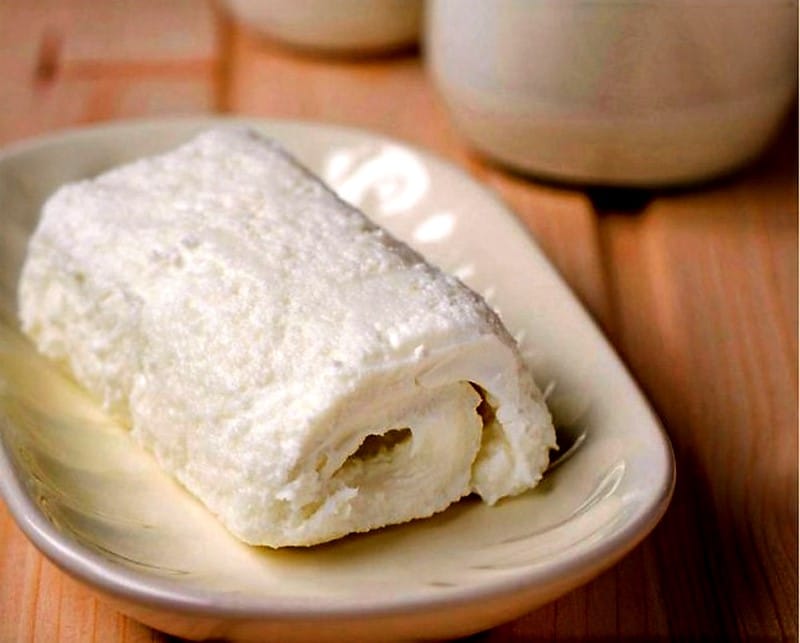
Kajmak (Balkan cuisine) : The kajmak (or kaymak) is a dairy product creamy similar to cream coagulated, made of milk de buffalo, cow, sheep or goat in Central Asia, in some countries of the Balkans, in some countries of the Caucasus, in the Turkish regions, in Iran and Iraq.
The traditional method of making kajmak is to make boil le milk slowly, then to leave it simmer for two hours over very low heat. Once the heat source has been switched off, the milk is skimmed and and the cream left cool (and slightly fermented) for several hours or days. The kaymak has a high percentage of fat usually around 60%. He has one consistency thick et creamy (not fully compact, due to fibers de protein of milk) and a taste very rich.
Etymology: The against kajmak a des origines turques d’ Asie centrale, peut-être formé du verbe kaymak, qui signifie to melt et mold metal (tin) In turkish. The earliest writings of the word kaymak are found in Mahmud al-Kashgari's well-known book Dīwān Lughāt al-Turk. The word remains as kaylgmak in Mongolian, and with small variations in Turkic languages like qaymaq in Azerbaijan, qaymoq in Uzbek, қаймақ in Kazakh and Shor, каймак in Kyrgyz, kaymak in Turkish, gaýmak in Turkmen, კაიმაღი (Kaimaghi) in and καϊμάκι (kaïmáki) in Greek.
In Turkey: Shops in Turkey have been devoted to the production and consumption of kaymak for centuries. The Kaymak is mainly consumed today with the Breakfast Turkish traditional. A type of kaymak is found in the Afyonkarahisar region where water buffaloes are fed from the seed residues of poppy pressed for theoil. Kaymak can also describe the mousse creamy Turkish coffee traditional “black”. Kaymak is traditionally eaten with Baklava and others desserts turkish people jams de fruits and miel or like garnish de pancakes.
In the Balkans: Known as kajmak, it is almost always made by hand. house, although there is beginning to be commercial production. The kajmak is the most expensive when it is frais – it only keeps for a day or two. It can be kept for weeks in the refrigerator but becomes harder and loses its quality. Kajmak can also be stored in bags made from dried animal skin; a variant is called skorup. The kajmak also describes the mousse creamy Turkish coffee.
It is generally enjoyed as an aperitif or for the Breakfast Saturday morning, because Saturday is market day with the best kajmak, but also as a condiment. The recipe the simplest is lepinja sa kajmakom (little bread filled with kaymak in Serbia) eaten for breakfast or as fast food. Bosnians, Montenegrins, Serbs and Macedonians consider it a national meal. Other traditional dishes with kajmak (sold in restaurants) include pljeskavica sa kajmakom (the Balkan version of a hamburger patty topped with melted kajmak), as well queribic u kajmaku (shank stewed beef with kajmak).
In Iraq it is called gaimar, geymar or qaimar and is very popular. Iraqi gaimar is usually made from the rich, fatty milk of buffalo of water, which are prevalent in the swamps of southern Iraq.
It is available both from the factory and from local vendors (farmers) commonly known as Arabs, Arbans or Madan, and is therefore sometimes referred to as Arab gaimar, maadan gaimar or farmer's gaimar.
Iraqis like to serve Gaimar for breakfast with pain frais, honey or jam. However, the most popular way is to spread it on a type of Iraqi pastry bread called "Kahi", "smother" it with date syrup, then wash it with tea hot. Gaimar on kahi with date syrup is a long-standing traditional breakfast throughout Baghdad and throughout southern Iraq.
In Iran: In Iran, sarsheer (سرشیر) is used to describe a different method that does not involve heating the milk, thereby keeping the enzymes and other cultures in the milk alive. The word kaymak (qaymaq) is also used for the porridge de milk. Qaymaq is a Turkish word used to describe this product among the Azari people of Iran.
En Afghanistan : En Afghanistan, le Qaimak ou le qaymaq a une qualité plus maintenance et est consommé pour les repas du petit déjeuner, généralement avec du pain. Les gens garnissent généralement le qaimak de miel, de sucre ou le mélangent avec de la confiture. Il peut être spread out on the pâtisseries or even added to tea au milk. The Qaimak can be purchased in grocery stores in Afghanistan or made at home. It's quite a lengthy process to do at home, involving hours of agitating the milk jug. Qaimak can be found in Afghan/Iranian grocery stores in the west, but is not as rich as homemade. While many variants of qaimak are made from milk de buffalo, Afghan qaimak can be made from cow's milk.
In Georgia: In the Adjara region of Georgia, bordering Turkey, კაიმაღი or kaimaghi is made from cow's milk in homes in the mountainous villages of Keda, Shuakhevi and Khulo. It is generally consommé with some cheese Georgian and/or du pain, and is only rarely served in restaurants.
In Greece: Kaimaki in Greece refers to the ice cream au mastic which is widely available and often served alongside desserts traditional Greek.