

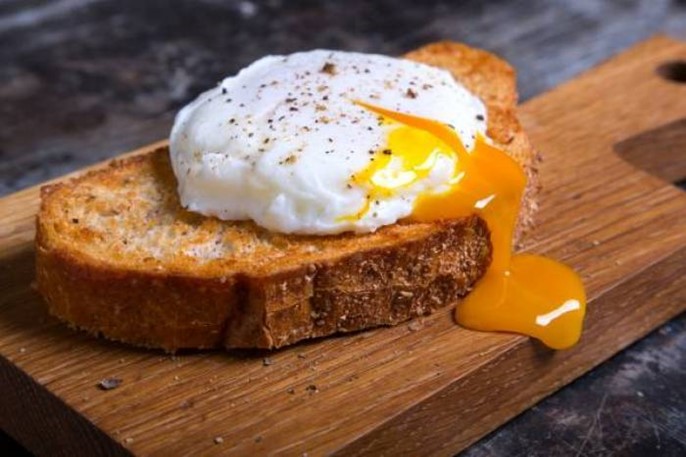
Perfect egg : Theœuf perfect is not a utopian egg. It is simply a baking egg in its shell, after which the White Is not solid et rubbery, and the yellow Is not Floury et sec.
Before going any further, what happens when you cook a œuf. White and yellow consist ofwater and protein, 90% water for the egg white for 10% protein. When the temperature increases, the protein are transformed and visually at 100°C (case of thepoached egg in thewater boiling) the white will become rubbery. On the other hand, if you can control the temperature around 65°C (*), which is the ideal temperature before the yolk coagulated, it is possible to obtain a yellow creamy but cooked, while the white will be cooked but in a semi liquid.
(*) According to some chefs, the cooking temperature of the œuf perfect should be between 64°C and 65°C. They even specify the figure of 63,2°C.
Thus by controlling the temperature of the two elements of the egg, we obtain a perfect egg.
Preparing the perfect egg: Not everyone has professional equipment, so you have to deal with your environment. The only essential element is the temperature sensor , without which we cannot achieve the desired result.
Here are three different cooking methods:
– Maintaining the water temperature at 65°C for 1 hour: in a pan filled with water, the difficulty lies in maintaining the temperature on the fire by adding lukewarm water or putting it back on the heat very briefly, thus compensating for the rise in temperature.
– Cooking by thermal inertia: in a large saucepan filled with water, heat it up and as soon as it begins to simmer, turn off the heat. When the temperature reaches 75°C, the eggs are immersed at room temperature and then left to cook covered.
Check after 30 minutes, if the temperature is above 68°C, cover and leave for another 30 minutes.
You have to check again: if the temperature is above 65°C, remove the eggs. If it is lower than 65°C switch on again briefly until 68°C then when the temperature drops back below 65°C, it is ready.
Another trick is to bring a medium pot of water to boiling, to cut the heating and y plunge egg (which is at room temperature) and allow 22 to 24 minutes of cooking, depending on the size of the egg. The perfect egg is ready.
- At four : it is also possible to make the perfect egg with four but unless you have a very precise oven it is quite difficult to maintain a constant temperature at 65°C. If you have one that is efficient enough then you just have to put the eggs on the wire rack du four and let them cook for 1h30 at 65°C.
It may seem complicated but again not everyone has professional equipment, as mentioned above it is a question of controlling the temperature and maintaining it.
The result is incomparable with what we are used to use.
There remains a final phase, theshelling : the breast is cooked but not firm, so when you break the shell you have to be careful with the breast whose consistency is relatively fluid.
Check Egg.