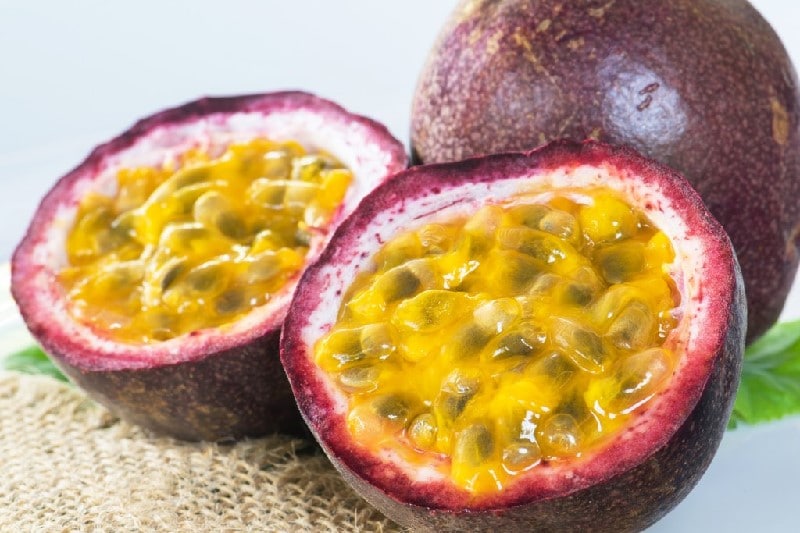

Passion fruit : Passion fruit is fruit by Liane ou plants climbing, The passionflower (family of Passifloraceae - Botanical name: Passiflora) Is native du Paraguay, Brazil and northeast ofArgentina, also cultivated in Africa, Australia and Malaysia.
Passionflower, also called “ grenadilla » or “Passion flower”, owes its name to the forms du the heart flowers, including organs evoke the various instruments of the Passion of Christ (apostles, wounds, crown of thorns, hammer, nails).
History of passion fruit: Passion fruit grows mainly in Countries tropical : located on South America (Brazil, Argentina, Colombia, Peru), in the islands (West Indies, Hawaii, Fiji), passing through theAfrica (Kenya, Ivory Coast, Angola), India and Australia.
most large producer in the world remains the Brazil. It was discovered by the Spanish in South America, in the XNUMXth century century, but it only arrived in Europe in the XNUMXth century century.
The name “passion fruit” has nothing to do with passionate love as one might think. Nor is it particularly aphrodisiac. The name comes to us from Christianity, because the Spaniards saw many symbols of the crucifixion of Christ on the flower of this fruit. Indeed, for them the petals represented the crown ofthorns carried by Jesus on the cross. Number of petals, which is 10, referred to the 10 apostles at the beginning.
Lesson 5 stamens represented the 5 wounds of Christ. And finally the pistol symbolized the hammer blows received. Hence the name “passion fruit”, linked to the “passion of Christ”.
The plant is cultivated for its fruits like vine, on the poles and wires in the regions tropical represented the 5 wounds of Christ. Hence the name “passion fruit”, in connection with the “passion of Christ” produced in the regions hot (corresponding to the area of theorange tree). His fruits are named passion fruit ou passion fruit (against d’origine tupi pour la forme yellow).
En New Caledonia, They are called apple-vines and in Haiti, Grenada.
There are around a hundred varieties including a yellow form of unknown origin, called yellow grenadilla (Passiflora f. flavicarpa). It is distinguished from the purple form (P. edulis f. edulis) by distinct natural distribution zones and by distinct flowering times. The yellow form flavicarpa is self-sterile while the purple form is self-fertile, its fruit is yellow to maturity while the other is deep purple and smaller.
As big as one œuf de hen, the Passion fruit is covered with a yellowish skin (it is then also called “maracuja”) or red-brown, smooth and shiny when it is not ripe. He has a pulp yellow-orange, yellow-orange, tangy and very perfumed, garnished with small seeds black groceries.
Low in calories (46 Kcal or 193 kJ per 100 g), passion fruit is rich en vitamin A and vitamin C, magnesium, mineral salt whose action on the sucre is beneficial for the prevention of diabetes. The magnesium is also beneficial for the relaxation of athletes, such as banane, to which he can therefore find an alternative.
Passion fruit contains more polyphenols than any other fruit tropical, according to a study carried out in 2016 by the University of Réunion
polyphenols are beneficial in the fight against inflammation, cardiovascular diseases and cancer.
La skin purple and hard from this fruit (when it is Wall), cannot be eaten. There is controversy over its possible toxicity, some researchers highlight the fact that it would contain, asalmond found inside some fruits à cores, a toxin related to cyanide, dangerous if weabsorbed en amount. On the other hand, the fruit is potentially dangerous for the people allergic au latex. A study carried out in 1997 at the University of Munster (Germany) revealed that the protein present in the latex Its similar to those of passion fruit.
One last point to mention that this fruit grows mainly in Countries distant to climates hot the main local are in America, Australia, South Africa and India.
the balance sheet ecological industrial printing process is therefore not terrible for consumers European.
Culinary uses of Passion fruit : It is eaten nature lovers, little spoon, with some sucre, eventually watered de kirsch or rhum. It is used for preparation de water ice cream, sorbets, drinks et syrups, jellies and creams sweet and is also suitable for giving a touch exotic to shellfish (langoustines, Saint Jacques...).