

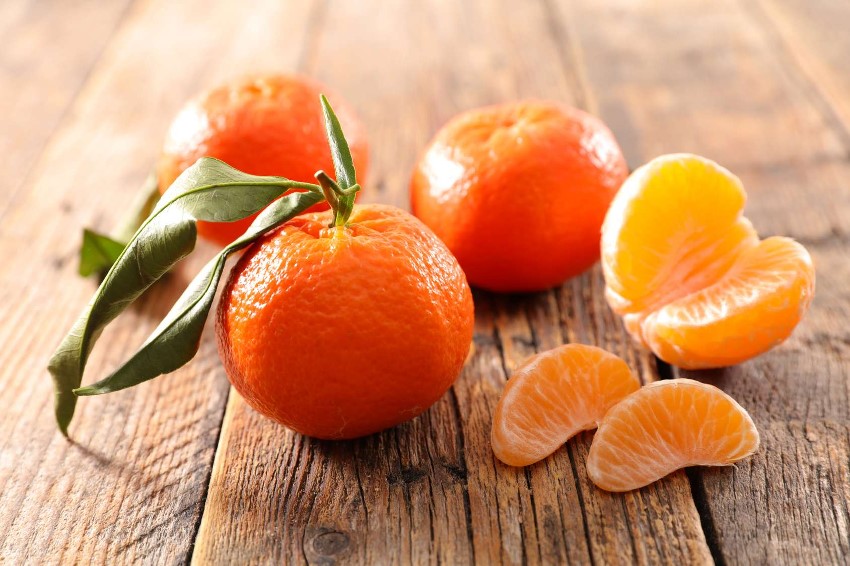
Tangerine: Tangerine is a citrus. It is the fruit of the mandarin tree, a tree native to China (family of Rutaceae - Botanical name: Citrus reticulata).
The mandarin tree is a small tree with shiny dark green single leaves. He is originally from Southeast Asia (China and Vietnam). It has only been known in Europe since the beginning of the XNUMXth century.
It is grown in Spain, Algeria, Tunisia, Morocco and the United States. In areas that are too cold, it is grafted onto the poncirus (a species of trifoliate orange tree) so that it can withstand harsher winters.
The common mandarin is gradually being replaced by its seedless hybrids, in particular the clementine (hybrid of sweet orange and mandarin) which alone represents 80% of the easy peeler market in France.
The remaining 20% are mostly occupied by hybrids, mainly clemenvilla (crossing of tangelos and clementine) and ortaniques (hybrids of tangerine and orange.
The fruit with a diameter of 5 to 8 cm is spherical and slightly flattened at its two poles.
Its flesh, sweet and has a very specific aroma, is one of the least acid among citrus fruits, but it has many pips. Its bark is thin, of a red-orange color.
Low in energy (40 Kcal or 167 kJ per 100 grams), it is rich in water (88%), potassium (200 mg per 100 grams), calcium (33 milligrams), vitamin C (30 milligrams) and acid salicylic.
A mandarin is generally divided into about ten segments. A quarter is sometimes called a splinter, a thigh or, in Périgord, a "perne", or even a "buttock" in eastern France.
Mandarin has several names, some referring to hybrids. Most early mandarins are of the Japanese variety satsumas (See Mandarin satsuma) which includes about 200 cultivars. Full-season mandarins are mainly Mediterranean and Asian tropical hybrids. ponkan » appreciated in India, Brazil…
Clementines, reputed to be seedless and with a fine taste, later, represent the most important variety commercially in Europe. The tangerine can be peeled with your fingers, starting with the top of the fruit. The wedges can be separated without wasting any juice. These qualities make it an easy-to-consume fruit.
Related Articles:
Mandarin satsuma
Mikan.
See as well Mandarine under Mouth slang.
Mandarin Culinary Uses : The mandarin is present on the markets from mid-December to May. Generally tasted nature lovers, she is also confection and used in cooking and baking like the orange; we can raise it flavor, in jobs sweet, with some kirsch or old fine. Its bark, on the other hand, is used to develop liqueurs.
The uses of tangerine are identical to those oforange. It is particularly appreciated as a fruit for the mouth. The peel and juice are used in drinks (liqueurs, condiments, beer, etc.), in Food salt et sweet.
Tangerine peel can also be used in medical preparations, especially in traditional Chinese medicine.
Tangerines will keep for about a week at room temperature. You can double this time by placing it in the vegetable drawer of the fridge.
Some savory culinary preparations based on mandarin:
Some sweet culinary preparations based on mandarin: