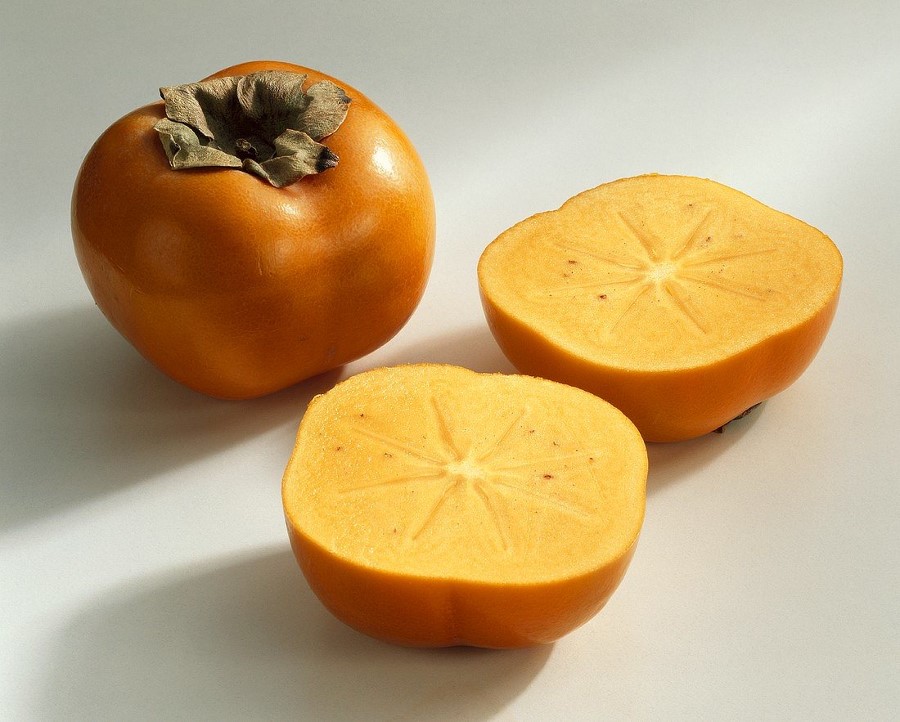

Kaki : Persimmon, also called persimmon Korea, persimmon China, or formerly fig caque, is the fruit persimmon, arbre from Japan (family of Ebenaceae - Botanical name: Khaki Diospyros).
The arbre measures 5 to 10 meters high. His leaves are simple, broad, oval and alternate, blushing green in fall. Its flowers, white, yellowish or greenish, are in bouquet for males and solitary for females.
The first botanical description of the tree is the work of a collaborator and former student of Linnaeus, Carl Peter Thunberg, who stayed in Japan in 1775-1776.
La pulp persimmon is enough soft and as orange as her skin. It contains from one to eight seeds depending on the variety and has a flavor sweet and sour, a little or enough astringent depending on the variety.
These persimmons or persimmons, fig caque, apricot of Japan) are fruits flattened very sweet of an orange-yellow which have the shape of tomatoes at the end flavor vanilla which recalls the pear (Intergovernmental Panel on Climate Change) and the apricot.
Providing 64 Kcal or 268 ‹J per 100 grams, persimmon is enough rich en Potassium (200 mg) and in vitamin C (from 7 to 22 mg).
Distribution of persimmon: Native to eastern China and national fruit of Japan and Korea, it is also grown in Brazil, Vietnam, Taiwan, Lebanon, Iran, Israel, Italy, Spain , in the United States, in the South of France and in Corsica, as well as in North Africa — more precisely in Morocco, Algeria and Tunisia. Some hypotheses give him as a wild ancestor a species growing from North-East India to Indochina. Today there are more than 2 varieties.
Description of the persimmon: The fruit can weigh more than 500 grams. It is orange in color, with translucent skin when mature. It can hold up to eight seeds and it stays on the tree after the leaves have fallen. It contains various pigments, carotenes, lycopenes and xanthines in abundance, and it is one of the richest fruits in provitamin A.
Persimmon is a fruit climacteric whose ripening can be controlled after picking, but it is best to pick it when fully ripe, almost overripe. The persimmon, left in the ambient air, will continue to ripen naturally. You can put it in a paper bag to speed up its ripening, or put it with apples in a non-perforated plastic box covered with paper. Once ripe, it can be put in the refrigerator where it will keep for a few days. It tolerates freezing well.
When they are ripe, they are very fragile fruits, which rot easily, and which are difficult to transport. It is therefore necessary to carefully choose this fruit on display. Despite everything, half of the Japanese production is made from astringent cultivars.
Etymology of the word kaki: The word kaki was borrowed from the Japanese kaki no ki, lit. persimmon tree.
The Greek root of the botanical name persimmon, Diospyros (fruit of Zeus), comes from Theophrastus who used it to describe a misidentified tree.
Joseph Banks, botanist on Captain Cook's first voyage in 1768, is credited with introducing Diospyros kaki to Europe.
In Chinese, the tree is called 柿子树 shizishu and the fruit 柿子 shizi. Europeans became aware of this fruit in the XNUMXth century thanks to Matteo Ricci, an Italian Jesuit priest and missionary in China.
In Belgium, some vendors call these fruits Persimons. The word designates in Spanish in a generic way the persimmons with firm flesh (from the English persimmon with two m). This word is affixed to the packaging, hence the possible confusion with the name of the fruit or the variety. The word persimmon comes from Persia, like the word "peach", another fruit from Asia.
In Switzerland, there are mainly persimmons from Italy which are astringent before their maturity, but there is a version called “Kaki Persimon” which is not astringent and comes from Israel.
Varieties of persimmon: The two best-known Japanese varieties are “Hachiya” and “Fuyu”.
The 'Brilliant Rojo' variety is well known in Spain where it has a Protected Designation of Origin Kaki Ribera del Xúquer. The fruit is non-astringent when ripe. The tree is vigorous and very productive.
In the People's Republic of China and Japan, the fruits of astringent cultivars are eaten raw or after being peeled and sun-dried for consumption the following winter and spring. In Japan, the astringency of fruits is eliminated by soaking them in hot water or by enclosing them in a chamber filled with carbon dioxide (80 to 90% for 24 hours) or ethanol vapor.
In some countries such as Taiwan, the astringent persimmons at harvest are soaked in sealed jars containing liquid lime, which removes their bitterness and gives them a certain crunch. The soaking time depends on the temperature; it lasts from five to seven days for an ambient temperature between 25 and 28°C. Alcohol (eg gaoliang) is also occasionally used.
Other species of the genus Diospyros are eaten, for example the fruit of the persimmon (Diospyros virginiana) which is used to to cook des pudding, during Persimmon Festivals in early winter in Indiana and Virginia.
See as well Kaki under Mouth slang.
Uses of persimmon : Available in the market French in December and January, imported fromItaly,Spain and Middle-East, the khaki must be consommé carefully Wall, and his pulp se tasted , little spoon. We make some compotes, jams, sorbets. It is used in pastryWithin pies et tatins
cakes.
Au Japan
pâtisseries offer it in cakes individual, variously prepared et embellished.
Not to mention the khakis dried which are offered over long boughs de wood twisted me on markets major Japanese cities.