

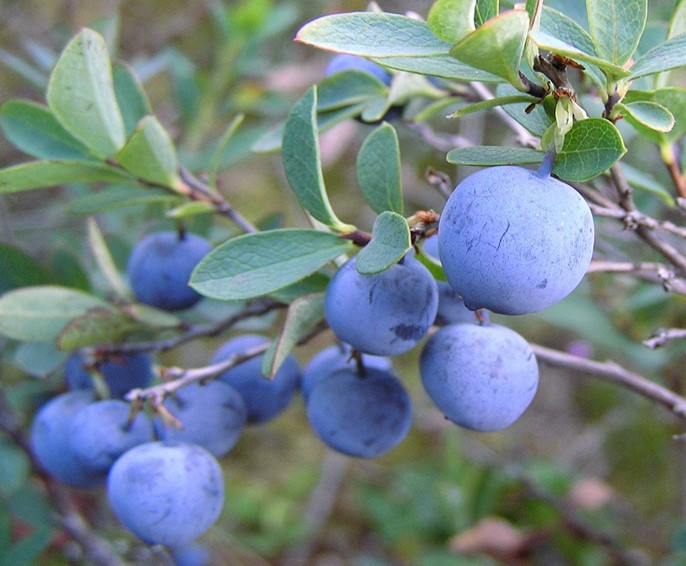
Blueberry : The blueberry blueberry comes from a sub-shrub, the blueberry of the marshes (family of heath - Botanical name: Vaccinium uliginosum), 30 to 80 cm wide. It is found in bogs, moors, subalpine rocky slopes and moist woods of the circumboreal mountains, between 500 to 3 m altitude (usually 000 to 900 m).
Denomination of the blueberry:
Name accepted, recommended or typical in French: Lingonberry swamps (Canada), bilberry or bilberry (France).
Other common names (popular science): Lingonberry, Blueberry.
Vernacular names (everyday language), which can also designate other species: wolfberry, trailing blueberry, orcette or sea spray.
Beware of confusion with the species Vaccinium myrtillus L., the blueberry. These are however without consequences, the fruits of the two species being edible and of very similar flavors.
Description of the marsh blueberry: The leaves, 15 to 25 mm long, thin enough to show a fine network of veins, are entire, obtuse at the top and glaucous. The twigs, brown in color, have a rounded section (unlike Vaccinium myrtillus).
From May to July, hanging flowers 5 mm long and greenish to whitish in color bloom.
The globose, blue-black berries look a lot like blueberries (Vaccinium myrtillus) but the inner pulp is white, not red. Also called "wolf blueberry", which indicates a lower nutritional quality than the common blueberry.
Swamp blueberries can sometimes end up mixed with pickings of Vaccinium myrtillus.
However, consumption in large quantities would cause dizziness and migraines.
Related Articles:
Lingonberry
Centaury
Blueberry