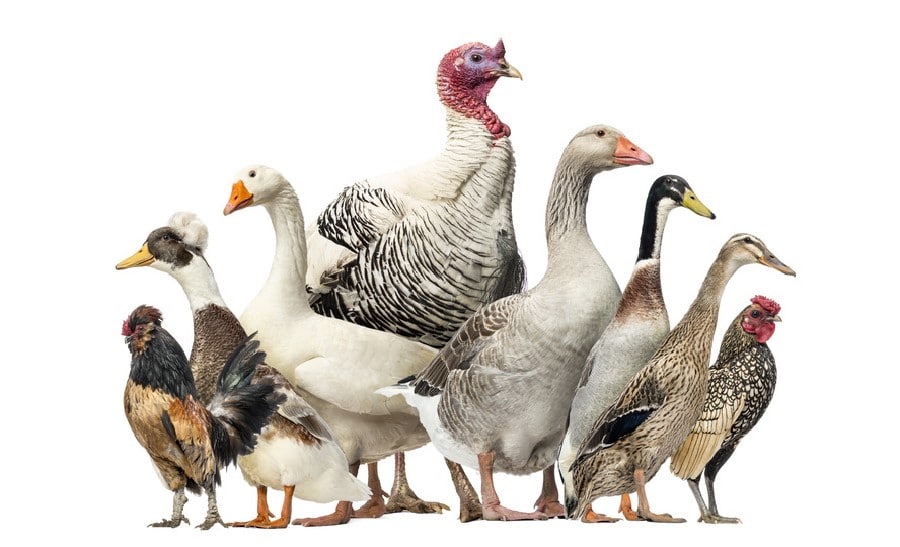

Poultry : « Volaille » est un spa générique désignant l’ensemble des birds bred for their chair or their eggs, or both (duck, cockerel, turkey, goose, pigeon, guinea fowl, hen, chicken). Par commodité de distribution, certains volaillers y added sometimes the rabbit domesticated. The meat these with animals has good content protein, from 20 to 23 g per 100 g, it also contains lipids (from 3 to 6 g per 100 g) and fer (de 1 à 2 mg pour 100 g). Elle est à l’origine de plats simple et économiques, de grands conventional régionaux et des préparations ? raffinées. De plus en plus de «charcuteries» industrielles sont confectionnées à leave de volailles. Les volailles sont souvent découpées en parts for collective catering.
En Food, we reserve the term "poultry" for chair de chicken or hen, when used in preparations de basis.
– Production moyenne en France. On patented 900 milliers de tonnes (en équivalent carcass) of chickens, 620 of turkeys, 300 of ducks, 120 of rabbits, 60 of hens, 38 of guinea fowl and 3 ofgeese. La France est le premier producteur de pintades du monde. L’élevage du duck s’y est développé, in one’s life. One of the main focuses is the dans le Sud-ouest, pour la production du foie gras and duck breasts. La France est aussi le deuxième producteur global de lapins, après la Chine.
Les volailles sont vendues éviscérées (ou prêtes à cuire), effilées (only les viscères abdominaux sont enlevés par le cloaque) ou immense vidées (topic saigné et plumé). Une volaille conditionnée pour la vente doit porter un chiffre de 1 à 4, indiquant le « calibre » de l’animal (weight, matters tenu de sa présentation : éviscéré, vidé, etc.) ; le 1 correspond à un volatile young, pesant au maximum 850 g, prêt à cuire. En outre, une lettre, A, B ou C, indicated the " class » de la volaille (degré d’engraissement, développement des muscles, plumes, défauts). Enfin, l’animal peut porter une étiquette ou un label (environ 250 actuellement), qui précise are origin.
Characteristics of the main poultry and rabbits
| Last Name | Origin | Era | Aspect | Distinctives features |
|---|---|---|---|---|
| Quail | the whole of France | all year | 150-200 g, round | fine flesh |
| Duck | ||||
| Barbary | the whole of France | all year | stout (3-5 kg), plentiful muscles | rather firm, fine flesh |
| White de l'Allier | Bourbonnais | all year | fairly stout (3,5-4 kg) | fine flesh |
| from Challans (or Nantes) | Vendée | all year | fairly stout (2,5-3 kg) | white, tasty flesh |
| colvert | northern hemisphere | Fall-Winter | small | firm meat, game |
| mulard (crossbreed) | the whole of France | all year | way à large selon le gavage | chair un peu grasse, goûteuse ;pour liver gras |
| from beijing | the whole of France | all year | fairly stout (3-3,5 kg) | fine flesh |
| de Rouen (clear) | Normandy | all year | fairly stout (3,5 kg) | very fine flesh |
| Capon-Poularde | Landes, Bresse | déc. | up to 6 kg | very fine, delicate flesh |
| Cock | the whole of France | all year | bulky (4-5 kg) | firm, tasty flesh |
| Turkey-Turkey | ||||
| American tanned | the whole of France | end of the year | 9-15 kg (male), 6-8 kg (female), black to reflections tanned | succulent flesh |
| Bourbonnais black | Bourbonnais | end of the year | 10-12 kg (male), 7-9 kg (female), black with metallic highlights | succulent flesh |
| black from the Gers | Southwest France | end of the year | 8 kg min. (male), 5 kg (female) | very fine flesh |
| Sologne black | Sologne | end of the year | 10-12,5 kg (male), 6-7,5 kg (female), deep black | excellent flesh |
| red of the Ardennes | Franco-Belgian Ardennes | end of the year | 10 kg max. (male), 7 kg (female) | very fine flesh |
| Goose | ||||
| d'Alsace | Alsace | end of the year | 4-4,5 kg, gris (main variété) | for foie gras |
| white Bourbonnais | Mix | end of the year | 7-10 kg, pure white | roast goose |
| white Poitou | Poitou | end of the year | 5-9 kg, pure white | for down |
| gray Landes | Southwest France | end of the year | 6-7 kg | for foie gras |
| from Guinea | Asia | end of the year | 4-5 kg | chair fine, less expensive oily |
| Norman | Normandy | end of the year | 4-5,5 kg, white jars, gray and white goose | excellent flesh |
| from Toulouse without bib | Southwest France | end of the year | 6-10 kg, gray | fine flesh, for foie gras |
| Pigeon | ||||
| Flue | the whole of France | all year | 600-675 g, red (main variety) | fine flesh |
| cauchois | the whole of France | all year | 650-800 g, mesh-coated (main variety) | fine flesh |
| King | the whole of France | all year | 850-1050 g, white (main variety) | productive pigeon |
| Texan | the whole of France | all year | 750-930 g, male and female in different colors | very productive meat pigeon |
| Guinea fowl | the whole of France | all year | 1,2-1,5 kg, ovoid | typical flesh, tinted |
| Hen-Chicken | ||||
| bourbonnaise | all of France, mainly in the Allier | all year | 2,5 kg (hen) to 3,5 kg (rooster), white herminated with black | fine flesh |
| Bresse | Bresse | all year | 2-2,5 kg (hen) to 2,5-3 kg (rooster), blue legs | excellent meat, capon |
| Faverolles | the whole of France | especially at the end of the year | 2,8-3,4 kg (poule) à 3,5-4 (coq), barbe et 5 fingers | excellent flesh |
| the arrow | the whole of France | especially at the end of the year | 3 kg min. (poule) à 3,5 kg (coq), crête en forms de cornes | chair excellent, chapon |
| gatinaise | the whole of France | especially at the end of the year | 2,5 kg (hen) to 3,5-4 kg (rooster), pure white | fine flesh |
| Touraine geline | all of France, mainly in Touraine | all year | 2,5-3 kg (hen) to 3-3,5 kg (rooster), black | excellent flesh, the hen is marketed under the name of "Dame Noire" |
| Gournay | all of France, mainly in Normandy | all year | 2 kg min. (hen), 2,5 kg (rooster) | fine flesh |
| Houdan | the whole of France | especially at the end of the year | 2,5 kg (hen) to 3 kg (rooster), crest, beard and 5 fingers | excellent flesh |
| Marans | the whole of France | all year | 2,6-3,2 kg (hen), 3,5-4 kg (rooster) | big extra soft eggs |
| Meuse | the whole of France | especially at the end of the year | 2,4-3,4 kg (hen). 3,4-4,8 kg (rooster), 5 fingers | excellent flesh |
| Sussex | the whole of France | all year | 3,2 kg min. (hen) to 4,1 kg (rooster) | very good flesh, white skin |
| Poussin | the whole of France | all year | 250-300 g | delicate flesh |
| Rabbit | ||||
| Champagne silver | the whole of France | all year | 4,5-5,25 kg, silver fur | fine flesh |
| Californian | the whole of France | all year | 4-4,5 kg, white with black ends | fine flesh |
| burgundy fawn | the whole of France | all year | 4-4,5 kg, fawn | fine flesh |
| white giant of Bouscat | the whole of France | all year | 6 kg and over, white | good flesh |
| giant of Flanders | the whole of France | all year | 7 kg and over, gray (main variety) | large meat yield |
| giant french butterfly | the whole of France | all year | 6 kg and over, white with black markings | good flesh |
| New Zealand | the whole of France | all year | 4,5-5,25 kg | fine flesh |
| Poitou rex | Poitou | all year | 3,5-4,75 kg, short fur | fine flesh |
| Russian | the whole of France | all year | 2,4-2,7 kg, white with black ends | excellent flesh |
History de la volaille : Au Moyen Âge, la volaille (avec le petit game) was sold by the “rotisseurs-oyers” and the “chicken houses”. Poultry was then called “chicken”; the breeding of pigeon was feudal privilege.
The pullet made its appearance in the XNUMXth century. During the Renaissance, poultry began to be fattened “on moult”. In the sixteenth century, the turkey came from America and the guinea fowl, forgotten since the Romans, reappeared thanks to the Portuguese, who brought it back from Guinea. From the XNUMXth century, a distinction was made between free-range chickens and those that were fattened. Muscovy ducks et geese were then more sought after than rabbits. In the XNUMXth century, thegoose était devenue un plat bourgeois, mais on faisait large cas des canards de Rouen.
Check les volailles sous Game.
See as well Poultry et Poultry under Mouth slang.
Citation de l’écrivain français Louis-Ferdinand Destouches, your Céline (1894-1961) : « Cascade il croyait en no one question gargamelle ! Il faisait lui-même son marché trois time par semaine…Il ramenait ce qu’il trouvait de plus chouette, de plus dodu dans la volaille, des dindes comme ci ! poulardes comme ça ! des gigots comme on n’en voit plus… ! à péter tous les plats au four ! des prés-salés super fins …quand il trouvait de la bécasse à nous la douzaine » dans le roman Guignol's band. (1952).
The most common poultry:
Careers culinary de la volaille : Autrefois, on commençait souvent par help boasting ou boil what had to be roast, and conversely, processes still used by large chefs.
The “technical” detectors. classiques de baking of poultry are the roast (most running), the poached, the ember and the stove (especially for with animals older or taller, as well as for giblets), the sauté, and sometimes the steam cooking or grilling.
Poultry stuffed is a preparation which is becoming scarce. Poultry livers, gizzards and, more rarely, ridges et kidneys de coq connaissent various emplois en Food.
La volaille donne lieu à des préparations hot ou cold, never raw.
En Food ménagère ou régionale, les plus usual sont les plats dits « casserole "Or" at the pan ", the fricassee, the messed up, the poule au pot and the coq au wine ; the most elaborate include theasp, the ballotina, the hot-cold, the medallions, the supreme, the turbans, the souffles, the bites, the vol-au-vent and the preparations " to the queen ».
Some classic poultry-based culinary preparations: