

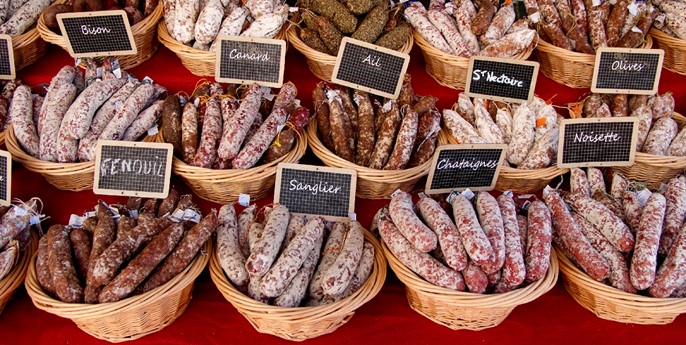
The varieties of sausages : they are numerous throughout Europe, and even in the world, and often reflect the habits of craftsmen and traditional as well as local products, includingseasoning and accommodation.
However, a distinction is generally made between sausages called " dry "sausages" cooked ».
Dry sausages : The manufacture of dried sausages is a very old tradition. It obeys precise rules which give these different specialties their aromaTheir texture and their taste : boning and trimming meat, preparation of the melee » (grinding of gras and skinny with spices), embossing, steaming (pre-drying at 20-25°C), drying and curing at 14°C, for at least 4 weeks.
A good dry sausage is farm au toucherOr major, with a noticeable aroma, covered with a "flower", a sign of a fermentation properly conducted, preferably bare.
It is served cut into thin slices washers from which we removed the skin, a delight, with some fresh butter, a appetizers, even in amuse bouche withaperitif.
A "gibet", a small table gallows intended to suspend several sausages, is sometimes used for a service rustic , with a small board cut.
Dry sausage is one of the assortments of charcuterie served during buffets country people ; he is also involved in sandwiches and canapés. It is also found in the form of balls (bells) or thin fingers (fingers) for theaperitif.
We distinguish, among the dry sausages:
– Household sausage: pure pork, medium size, with a hash quite large, which is eaten barely dry (the designations “countryside”, “rustic” or “like on the farm” have no legal value).
– The mountain sausage: pure pork, With a hash ? coarse, in one gut irregular large diameter (5 to 8 cm), which tends to become a superior quality of household sausage.
– Dry sausage: pure pork, presented in a necklace, by more or less small and dry elements, or U-shaped or straight, often bearing the name of its region of production (Auvergne, Provence, Pyrenees, Ardèche).
- The Arles sausage is a charcuterie from Bologna (Italy) which was imported to Arles in 1655 by the Arles butcher Godart.
– Chasseur sausage: small, often quite fatty, which combines meat de porc and beef, even game and does not keep for long.
– Dry sausage from Limousin (central France) benefits from the red label.
- The rosette : in spindle tied, pure pork, matured with care when it is authentic, and whose hash is finer. The rosette of Lyon is undoubtedly the most famous sausage, as well as the Jesus of Lyon and the Jesus (without "s") of Morteau.
- The Jesus of Morteau : large traditional smoked ovoid sausage from the East of France similar to Morteau sausage. It is made with meat de porc smoke traditionally in a tipped. It is out of respect for the name of Christ that many Mortuacians write “jesus”, a spelling totally ignored for the Jesus of Lyon.
– Dry sausage from Lyon: straight meat skinny is chopped finely and embellished with small Cubes de gras taken from the backrest du porc (bacon without meat). It can also be made up to a quarter of meat de beef (not to be confused with the brains of Lyon, to cook), which gives it a color dark.
- The boutefas : large to very large sausage, a Swiss specialty whose production and name are both Friborg and Vaudois.
- The sausage : originating in Spain and the Basque Country, it is made from meat de porc or beef embellished withgarlic, pimento red (or Espelette pepper for the txorizo of the Basque Country) and Pepper ;
- The figatellu or Figatelle: specially made meat and liver de porc which is a bit piquancy ; it is originally a Corsican specialty.
– Les grelots: small round sausages, Savoyard speciality, trademark registered by the Mont Charvin salt meats. Based onshoulder and chest de porc which gives these candy " a texture mellow.
To be enjoyed duringappetizers and at any time.
- The lukinke : specialty based on porc slightly spice from the Basque Country, in particular from the province of Soule. It is eaten hot or cold.
- The Lacaune sausage or Monts de Lacaune: dark red dry sausage, very skinny, it does, however, contain bacon de gras entire. It is produced in the south-east of Tarn (French department of the Occitanie region, crossed by the Tarn river which gave it its name).
- The Lorraine spindle : it's a long sausage smoked… from Lorraine.
- The Ardennes sausage : Belgian Ardennes sausage specialty smoked.
- The salamis : they bring together a wide variety of sausages from Italy with a fine paste, porc et beef, often smoked.
Buy here and at the best price on the market your different dry sausages:
Varieties of dry sausages :
- sausage cutting “à la perch” or sausage cutting proper.
– dry sausage in oil: specialty of Aveyron, it is in fact a sausage cutting kept in theoil.
– Catalan whip (in Catalan catalan fuet): dry sausage made from meat de porc, salt and / or peppery, very maintenanceor a savor flood or with pain. There are various kinds, such as plain whips,garlic visit us at the pimento visit us at the cheese, to pinions,…
Dried sausages accommodated :
– sausage with Pepper
– sausage with miel
– sausage with grape marc
– sausage with Hazelnut
– sausage with pistachios
– sausage with Almonds
– sausage with noix
– sausage with blueberries
– sausage with grapes
– sausage with beaufort
– sausage with Roquefort
– sausage with genepi (Savoyard specialty).
– sausage with figs
– sausage with herbs of Provence
– sausage with fennel
– sausage with Blue
– salami dried tomato
– sausage with olives

Cooked sausages : Certain charcuterie products, used in cooking (in brioche or dough, a garnish) or served in appetizers hot, lukewarm or cold, are cooked sausages, such as the widely consumed garlic sausage.
– The sausage of Paris: (or “Paris garlic”, when it is flavored) is characterized by a hash large, with very little farce. He intervenes in the garnishes de sauerkraut and also used in washers.
It is related to cooked sausage, or garlic sausage, smoked or not, in which the content of porc exceeds 25%. It is sometimes also called " brains"
– Lyon saucisson: 5 to 6 cm in diameter, is made of a thin paste made from veal and porc, sometimes with parts pork the size of hazelnuts, very often pistachio.
Let's mention, from the same family, the princess sausage, incorporating diced language de beef.
– Liver sausages: with a fine paste, also including pork or veal, spread cold on country bread to canapés.
– Cambridge sausage: This is a specialty of English origin, made up of a farce maintenance de meat de veal and porc, embellished with dice de ham, language de beef or White de volaille. He uses in appetizers, and can appear in a mixed salad.
– Tongue sausage: it combines a farce and language, embossed in a spindle de porc. It is generally pistachio.
– Krakow sausage: smoked, it is based on meat veal and porc, chopped very end.
– “Black” sausages: these are sausages smoked with small dice de gras coming off in a paste maintenance and color dark.
- The Vaudois sausage : Swiss specialty from the canton of Vaud which is more akin to Morteau sausage of Haut-Doubs.
- The bologna : they are assimilated to (large) cooked sausages: they are all large in diameter, with large dice de gras coming off in a paste maintenance and color Claire.