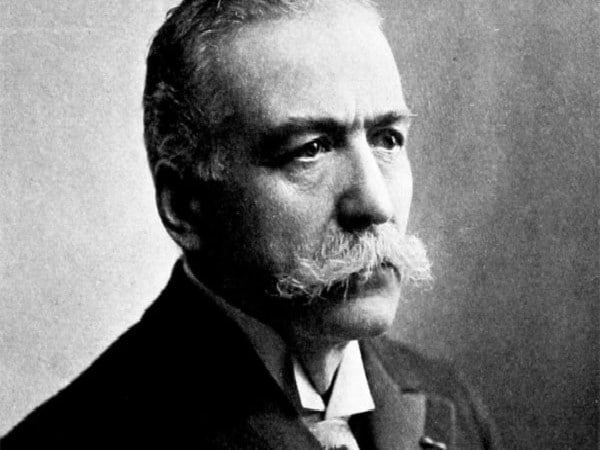

Escoffier (Augustus): Auguste Escoffier is a Chef French (Villeneuve-Loubet, Côte d'Azur – 1846 – Monte-Carlo 1935).
This "king of cooks" and "cook of kings" has modernized and codified the refined cuisine of Marie-Antoine Carême. Creating numerous recipes in prestigious establishments that were later taken up by other chefs, he made French cuisine known internationally.
He was a culinary writer influencing subsequent generations.
He also developed the kitchen brigade concept, rationalizing the distribution of tasks in the team and ensuring the cook's brand image (clean, meticulous, non-drinker, non-smoker, non-screaming).
This chef, the most famous of his time, was the first cook to become an Officer of the Legion of Honor.
He was born in the village of Villeneuve-Loubet, near Nice, to Jean-Baptiste Escoffier (blacksmith, farrier, locksmith and manufacturer of tools for cultivation) and Madeleine Civatte. His grandmother is a cordon bleu, three of his uncles and his aunt work in restaurants. At the age of thirteen and when he dreamed of becoming a sculptor, he was apprenticed as a kitchen boy at the "French Restaurant", the Nice establishment of one of his uncles, where he was introduced to purchasing, kitchen and room service; he learns fruit confectionery from a neighboring pastry chef. Then, in 1863, he moved to the “Cercle Masséna” as first assistant and became chef at the “Restaurant des Frères Provençaux” for the summer season, before being hired by Philippe. At the age of 19, he was hired at the Parisian restaurant of the "Petit Moulin Rouge", a social cabaret on Avenue Franklin-D.-Roosevelt where, after having first done everything, he worked as a commis roaster then Chef Garde- eat, finally Chef-saucier. It was there that he made the decision to become a chef de brigade in a great restaurant and used to present his dishes in the dining room to his distinguished guests, especially during the Universal Exhibition in Paris in 1867.
He invented new dishes there and dedicated them to famous guests, such as the "Eugénie salad" in honor of the Empress at Abd-El-Kader, the "Coupe Blanche d'Antigny" and the "noisettes (of lamb ) Cora Pearl” in honor of famous demi-mondaines, “Sarah-Bernhardt strawberries”, “Garibaldi timpani” or “George Sand chicken supreme”.
At the start of the Franco-Prussian War of 1870, he was appointed head chef first at the headquarters of the Army of the Rhine in Metz, then at the headquarters of Patrice de Mac Mahon, a prisoner in Wiesbaden where he generally served. at noon a dish of eggs or fish, a dish of meat with vegetables, a dessert or a dessert and coffee; in the evening, after the soup, a fish precedes a large piece of roast beef or mutton, a salad, vegetables and the meal ends with entremets and dessert, and coffee. His experience in the army taught him to use leftover food, to invent recipes to vary the presentation of the endless turnips available and that of the horse meat that was eaten (pot-au-feu or braised) to leave the beef to the sick; it will lead him to study the technique of food canning.
Three years later, returned to Paris after a season in Nice, he was chef at the "Petit Moulin Rouge" and in 1876, he bought a food business in Cannes, "Le Faisan Doré", and added a dining room to it. the winter seasons. On August 15, 1878, he married Delphine Daffis with whom he will conceive three children: Paul, Daniel and Germaine. After the death of his father-in-law, the publisher Paul Daffis, followed by other family deaths, he sold his business and took over the management of Maison Chevet, in Paris, for eight months, which organized large dinners both in the capital in the provinces and abroad (Germany, England, etc.).
The decade 1880 to 1890 saw the construction of a series of large hotels in the industrialized world following the increase in mobility offered by the development of the railway. Escoffier divides his time between Paris and Cannes, then from 1884 between Monte-Carlo, in winter, where he still holds the position of chef at the "Grand Hôtel" run by César Ritz, and Lucerne, where he reigns supreme. "Grand National" in the summer.
The collaboration of Escoffier and Ritz will result in the creation of the luxury hotel frequented by the European aristocracy and the most famous artists. The restaurants in these hotels break with old traditions and respectably welcome ladies who previously dined in their private apartments; the dining room of hotels becomes the fashionable place where one can show off one's clothes, the personalized table replaces the table d'hôte.
In 1890, he directed the kitchens of the Savoy Hotel in London. Many anecdotes remain from this period: Escoffier served the Prince of Wales an exquisite recipe for pancakes which he offered to dedicate to him, and the future Edward VII replied: “not at all, I am not worthy of it. We will name this marvelous thing after this young person who is with me” and thus were baptized the crepes suzette. Another time, he succeeded in serving him frogs' legs, despite the revulsion of the English for this batrachian, by presenting them to him under the name of "nymph's legs". He continues his creations, such as the Supreme de Poultry Jeannette, the Néro Bomb and the peach Melba in 1893, dedicated to a singer then famous, Nellie Melba, who had triumphed in Lohengrin. He invented menus at fixed prices for at least four people and promoted products that he brought from France, such as green asparagus from Avignon. But he also sees to it that the Little Sisters of the Poor can recover every morning, for their work, the wasted or barely fresh food (coffee grounds, tea leaves, bread for ornaments, even quail which only lacked the white that had been served at dinners the night before).
In 1897, César Ritz and Escoffier were dismissed from the Savoy: Ritz and Echenard, the butler, accused of the disappearance of wines and spirits, Escoffier for having received gifts from suppliers.
In 1898, he organized in a revolutionary way the installation of the kitchens of the hotel that the Ritz Development (with which he is associated) has them built in Paris, and he directs them; the following year, he returned to London to install those of the “Carlton” and remained there until 1920, directing a brigade of sixty cooks and perfecting an organization essential to be able to serve some five hundred covers at each meal.
His multiple functions do not prevent him from publishing books, composing the kitchen brigades of many other hotels around the world, such as the Ritz in London, or fitting out the kitchens of the ocean liners of the Hamburg America Lines : in 1906, he organized a dinner there for the German emperor Guillaume II who would have said to Escoffier: "I am the emperor of Germany, but you are the emperor of cooks!" The sentence, widely taken up in the press, would be apocryphal.
In 1911, the "Carnet d'Épicure" was born, a magazine founded in London and through which Escoffier wanted to contribute to the development of tourism in France; the First World War put an end to it in August 1914.
In 1912, he concocted the menus of the "Epicure's Dinners", intended to make known the excellence of French cuisine, which were tasted the same day in different cities, the first of which brought together more than four thousand guests around the world. and the last of which, in June 1914, was carried out in 147 different cities for a total of ten thousand people. During World War I, during which his youngest son died on active duty, he continued to run his restaurants.
On November 11, 1919, he received the Legion of Honor and, in 1928, became the first cook officer of this order; he is also honored by other countries, including England. He wrote the preface to the gastronomic Larousse which was to appear in 1938.
In 1920 he left the Carlton and England to join his family in Monte Carlo; he wrote his memoirs, articles, recipes. In 1922, he collaborated with the Maggi firm and recommended its products to housewives. In 1923 he was awarded the Daneborg Cross, granted by the rulers of Denmark. He participated in several culinary exhibitions in Frankfurt, Grenoble, Zurich. He died two weeks after his wife and is buried in the family vault of Villeneuve-Loubet.
The most famous chef of his time, Auguste Escoffier definitively imposed knowledge of French cuisine on an international level, both through that practiced in his restaurants and through his work as a culinary writer, thus extending and going beyond the work ofAntonin Lent and Jules Gouffé. However, by modifying the order of the menus, the preparation of the dishes, by limiting their richness, by eliminating the flour from the sauces in favor of stocks and meat glazes, by modifying the structure of work in the brigades, he innovated and is at the base of the transformation of the culinary art since 1918. He succeeded in widely sharing his conception of this art: the search for perfection in the preparation and the pleasure of the mind during the meal.
Speaking of the obligation to modify culinary practices under the pressure of busy customers, he asserts: "In a word, cooking, without ceasing to be an art, will become scientific and will have to submit its formulas, which are still too often empirical, to a method and a precision that will leave nothing to chance. and insists: "A gradual change will inevitably be necessary in the human diet." Assuming that the same quantity of nutritious principles is necessary for our grand-nephews, they will have to look for them in a food largely stripped of inert and unusable materials. This leads us to consider the reduction in the volume of meals as one of the unavoidable necessities of the future and constitutes one more argument, at the same time as a new justification of our opinion, in favor of rather short menus. »
He imposed new rules of conduct in terms of hygiene and cooking and trained many students and disciples: Paul thalamas, Paul Jullemier, Eugene Herbodeau, Joseph Donon, etc.
Escoffier also highlighted the copyright issue. While artists, writers, musicians, inventors are protected by law, the cook has no recourse against the plagiarism of his work. A dish which has all the characteristics of an individual and voluntary creation but which is widely appreciated and therefore prepared in many places, somehow falls into the public domain to the point that it is generally not known who invented it, when, where or how.
Nearly a century later, his "culinary guide" remains the cook's bible.
The Office of Postage Stamp Emissions (OETP) of the Principality of Monaco honored his memory by issuing a stamp on December 1, 2006.
Various high schools bear his name both in mainland France (vocational high schools in Cagnes-sur-Mer, a neighboring town of Villeneuve-Loubet, and in Éragny-sur-Oise) and overseas (hotel school in Nouméa).
There is a very active order of disciples of Escoffier, whose website is here: The Disciples of Escoffier.
Finally, there is the Escoffier Museum of Culinary Art located Villeneuve-Loubet Village, department of Alpes-Maritimes (e-mail address : info@musee-escoffier.com).