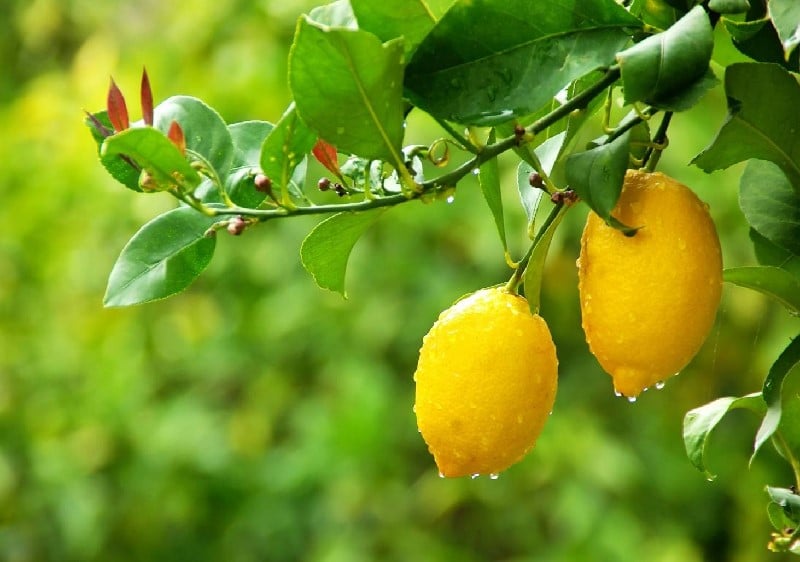

Lemon : Lemon is a citrus, fruit of the lemon tree (family Rutaceae - Last Name botanique : Citrus limon) which is a shrub 5 to 10 meters high, with leaves persistent. Lemon a la pulp acid et juicy. It is protected by a bark yellow, perfumed, more or less thick which ranges from soft green to bright yellow under the action of cold. Maturity is in late fall and early winter in the northern hemisphere.
Its flesh is rich in vitamin C, which is why – with its easy preservation – it has been distributed all over the planet by sailors who use it to prevent scurvy. From the bark is extracted a Essential oil which contains, among other substances, limonene and citral.
Sweet lemons are the fruits of cultivars with little or no acid juice nevertheless classified Citrus limon (L.) Burm. f. (Tanaka classification).
Le lime, or lime, is a citrus fruit close to lemon, as well as lime, or sweet lime, and citron.
History of lemon : Originally from India or Malaysia, the lemon tree was first introduced in Assyria, then in Greece and Rome, where the "medic apple", a citron, ancestor of the lemon, was used as a condiment and for its properties medicinal.
Le philosophe (et botaniste) grec Phanias d’Érèse semble faire soupçonner que le citron peut tirer son nom du against cédron.
In the Middle Ages, the Crusaders brought certain citrus fruits from Palestine, including the lemon, which began to be cultivated in Spain, North Africa and Italy. In France, until the XNUMXth century, schoolchildren traditionally offered lemons to their masters at the end of the school year (offering of the afterwards).
Lemon was also used as a beauty product (it was passed on to women to make the lips nicely red and the complexion very pale, according to the fashion of the time), but, above all, it was an essential remedy against scurvy (which manifests itself by multiple hemorrhages and which often struck the crews at the time of the navy with sail), because it is very rich in vitamins C and PP, citric acid and calcium.
Common varieties of lemon : These varieties are selected for their commercial value: productivity, richness in juice, ability to be harvested all year round, in fact the lemon is a citrus fruit which mainly matures in winter but is appreciated in summer.
– Eureka: Californian variety (XNUMXth century) which grows all year round and in abundance; it is the most common lemon in the supermarket.
– Fino: probably early of Spanish origin, this variety is vigorous and productive. It is also known as Mesero, Blanco and Primofiori (or Primofiore).
– Lisbon: old variety of Portuguese origin, acid, which produces a lot of juice and stays on the tree for a long time. Their shape is similar to that of the Eureka variety. It was formerly known in France as the "Madeira lemon".
– Meyer : variété de citron décoratif d’origine chinoise, probablement issue d’un croisement entre un oranger et un citronnier. Elle a la particularité d’être plus orangée, d’avoir une peau plus maintenance et une pulpe peu acide. Elle a le nom de Frank N. Meyer qui la découvrit en 1908. Extrêmement productif il est devenu un fruit utilisé en Food avec la cuisine fusion californienne.
– Verna (or Berna): Late Spanish variety – ripening at the end of February – among the most cultivated locally. The medium-sized fruit is practically seedless.
– Villafranca: one of the varieties of lemon grown in Menton, southern France.
– Yen Ben: Australian variety created in the 1930s.
The lime is not a variety of lemon, but that of a citrus fruit with a different scent and flavor: the lime.
Lemon Protected Geographical Indications : The colors, aromas, flavors, degree of acidity or sugar, the richness in essential oil vary according to the varieties, the soils, the climates, the maturity, the age of the lemon tree and the type of rootstock, forming a palette of unexpected tastes.
The diversity of lemons is not reflected in the catalog of registered varieties. From the Mediterranean climate to the tropics, there are many local cultivars resulting from propagation by seed. These include giant lemons that are not marketed because they are low in juice.
There are currently six IGPs in Europe, all in Italy.
They are: Limone di Rocca Imperiale, Limone di Siracusa, Limone Interdonato Messina Jonica, Limone Costa d'Amalfi, Limone di Sorrento and Limone Femminello del Gargano.
The Malaga variety is a sweet-juiced lemon with an aromatic zest that is eaten locally whole, in salt and at Easter.
These cultivars are often old, the lemon having been cultivated since the Roman Empire, the Andalusian Arabs were largely involved in the selection. Cultivation methods are sometimes sophisticated, the two IGPs of the Amalfi Coast are shaded during the summer. The IGP Citron de Menton project is progressing, it is a variety with small fruits typical of the Gulf of Genoa, grown in an extremely northern protected area for lemons.
World lemon production and transport : It is mainly grown in India, Mexico, Argentina, China and Brazil.
| Production in tons of lemon and lime. 2015 figures. Data from FAOSTAT (FAO) |
|||||
| India | 2 629 200 | ||||
| Mexico | 1 891 400 | ||||
| Argentina | 1 113 380 | ||||
| China | 1 058 105 | ||||
| Brazil | 1 020 350 | ||||
| USA | 800 137 | ||||
| Turkey | 787 063 | ||||
| Iran | 706 800 | ||||
| Spain | 578 200 | ||||
| Italy | 522 377 | ||||
France produces a few hundred tonnes a year in the Alpes-Maritimes and Corsica.
The lemon is transported by ships or reefer containers at 10°C. After loading, the temperature can be adjusted to -2 or -3°C for a period of time necessary to kill lemon canker or prevent its growth in the cargo or container, thus preventing its loss through cankered lemons.
For sale, lemons are classified into categories (between I and III) and sizes. Sizes 4 (approx. 125 g) and 5 (approx. 100 g) are the most common.
Uses of lemon : Lemon has many uses in Food, pastry, confectionery and in the industry drinks.
At room temperature, it can be kept for ten days, but once cut (or cooked), it loses its vitamins, so it must be consumed quickly.
Lemon fruit: Lemon slices or wedges accompany the seafood platter, fried foods and savory donuts, as well as various breaded dishes; they are traditional with tea. Lemon wedges season certain stews and stir-fries, as well as tagines. Candied lemons in brine are widely used to flavor fish and meat in Maghreb cuisine, where they sometimes replace traditional lemons. limes (nipple lime or Marrakech lemonette). Lemon is used to prepare jams, marmalades, lemon curd, chutneys and pies. Finally, the whole lemons are getting ready frosted ou frozen.
Lemon is used in pastry, especially in the recipe for pie with lemon and especially the lemon meringue pie.
The lemon condiments some Sauces. It is used in large quantities in the preparation of refreshing ice, sorbets et granitas, as well as in beverages refreshing.
Le lemon juice : It is obtained by simple pressure or with a juicer and it enters many culinary preparations in greater or lesser quantity: blanquette, stew, meunière, etc,…
First of all, it serves as a natural antioxidant (to prevent the darkening of certain white vegetables such as asparagus or turnips). Once peeled, fruits and vegetables darken on contact with air by oxidation. To save the vitamins, just rub the flesh of fruits (apple, pear, avocado) with half a lemon.
For rawness grated like celery root, it must be sprinkled with lemon juice.
It appears in marinades and court-bouillons, and replaces vinegar in the seasonings of raw vegetables and salads.
Enfin, la macération du fish cru dans le lemon juice (as the ceviche) constitutes a mode of “ baking very popular in South America and Oceania.
Adding some drops lemon (or vinaigre) makes the pastry softer and less elastic, because theacid break it up gluten (protein of the all-purpose flour).
Alcohol can be produced from lemon, such as lemon liqueur.
It is also an essential ingredient of lemonade, Limoncello and the very popular cherbet drink in Algeria.
Anecdote : Dans le monde du renseignement, il existe un proverbe qui que si le citron était intelligent, il donnerait tout son jus sans se faire presser.
Lemon zest and rind: Citrus fruits are often treated with diphenyl (mention specified on the label), it is preferable, to use the rind, to choose organic or untreated lemons. The zest can be obtained by grating it, peeling it with a paring knife or rubbing it with sugar, depending on the intended use. It is used as a flavoring, most often in pastry (creams, flans, mousses, soufflés, pies, madeleine), as well as its candied bark, or “citronnat” (biscuits, cakes).
Extrait : Le citron s’utilise en confectionery et en liquoristerie sous forme d’arôme naturel. Il parfume aussi certains thés aromatisés.
Check Cocktail, Fruit juice, Lemonade, Citronnade.
See as well Lemon under Mouth slang.
Lemons, the color of oil and the flavor of cold water, hung among the twisted lemon blossoms.
The birds with their beaks hurt the pomegranates. And almost all the figs were split.
Guillaume Apollinaire (1880-1918) in Le Thief.