

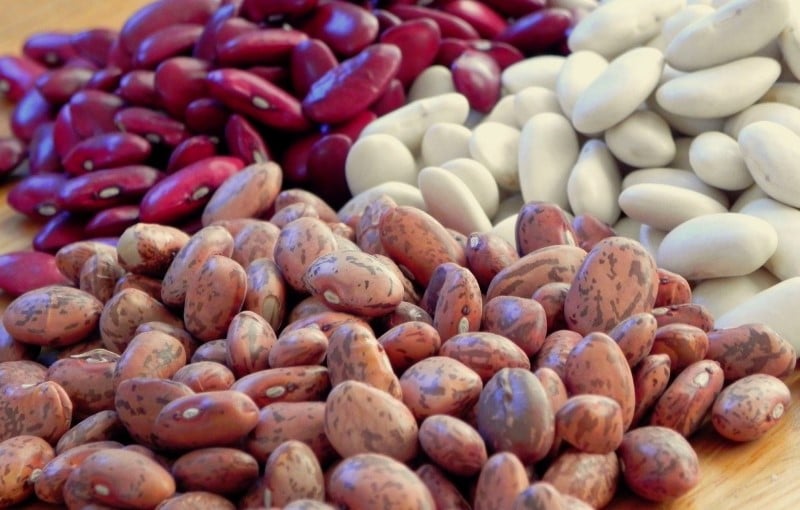
Dry bean : The dried bean (or grain bean) is a legume of the family Fabaceae, produced mainly for its dry grain. Certain varieties, shelled and dried before being marketed, are very famous.
The types of dry and semi-dry beans are usually differentiated by color:
- The Red bean is a medium-sized bean, ranging in color from pink to dark red. It has a creamy texture and a strong taste. When canned, it retains its shape and texture. It is produced in particular in North America, China, Argentina and Madagascar. Cooking time, 45 minutes to 1 hour.
- The pinto bean, or rosé, is a bean related to red beans because its skin turns pink when cooked. It is veined and has a floury texture. Cooking time, 45 minutes to 1 hour.
- The black bean is a medium-sized bean, black in color, oval and with a mild flavor. It is most consumed in North America and South America. In Mexico it is used in dishes, soups and also salads. Cooking time, approximately 1 hour.
- The marbled bean, or coco rose or borlotti or borlotto, is a dark red veined bean. It is mainly produced in Italy, North America and South Africa. The roman bean, or romano, stands out because it is spotted with red spots and its pod is also spotted in the same way. Its flavor is sweet. Cooking time, 40 minutes.
– The white bean, with its mild taste, is the most cultivated bean in Europe. It is a variety of beans whose pod is almost white. It includes several species (Mogette, Coco de Paimpol,…). It is a very popular bean in Italy, especially in Tuscany. Cooking time, 40 minutes. White coconut, an oval-shaped white bean, is very popular in England on toast with tomato sauce. Cooking time, approximately 45 minutes to 1 hour. The Pont l'Abbé kidney is one of the varieties protected by enthusiasts.
- The ingot bean : Large, elongated and very white, they are produced in the North, in Vendée and in the Castelnaudary region (South-West); drying ensures a long shelf life.
Produced in smaller quantities, Soissons, rooster kidneys, white Swiss, white coconuts are just as good. Dried beans, like fresh shelled beans, are used in typical regional preparations.
- flageolets : Very fine, white or green, not very floury, they are grown in the Arpajon region, in Brittany and in the North; Picked before maturity, from August to September, green flageolets are also called “goatherds” from the name of the gardener who created the variety. They are sold, after being air dried, canned or frozen. Flageolet is a highly esteemed dwarf bean, the imperfectly ripe grains of which are eaten. Flageolet is a pale green bean, thin, flattened and less floury than most other legumes. It is particularly esteemed in France where it traditionally accompanies leg of lamb and pork shoulder. It is mostly available dried or canned.
- The crow beans or dolic, white beans centered by a black spot, also called "black-eyed beans", are very popular in tropical Africa, but belong to a different species, Vigna unguiculata subsp. unguiculata. This, formerly Phaseolus unguiculatus (L.) Piper, is one of those that have been reclassified in the genus Vigna.
- The coconut beans Yin Yang, (Phaseolus-vulgaris-var. starazagorsky) are so named because of the coloring of its round black and white grains.
- The risina bean : small white beans with a very fine and very sought-after taste. They are grown around Lake Trasimeno, a preserved place with a mild climate south of Siena.
See as well Haricot under Mouth slang.