

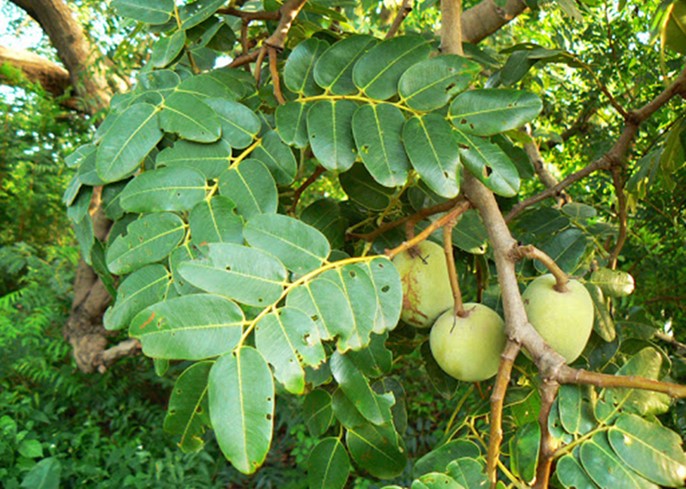
Ditax : The ditax or ditakh (Botanical name: Detarium senegalense) is a species ofarbre African of the Detarieae tribe (family of Fabaceae).
Unlike most Fabaceae, it produces fruits spherical. It also has other names vernacular ditakh, detar and "tree to tallow " (in English : tall tree). It is used in several ways: it provides fruits groceries, ingredients for traditional medicine and quality wood. It could therefore contribute to food security, sustainable agriculture and rural development. As his binomial name suggests, he is a native of Senegal and other West African countries.
Description: The ditax is a tree that can reach 40 m in height. Like most Detarieae, it has irregularly arranged thick branches. The trunk of adult trees typically reaches 60 to 100 cm in diameter. Its fruit is a drupes dark green spherical containing a pulp fibrous surrounding a single seed. This arrangement is close to that of the fruits of the tamarind tree, which also belongs to the Detarieae tribe. There flavor sweet and sour of the fruit is appreciated and this one keeps well on the stalls, thanks to its skin thick and its dry pulp. To exploit more widely this tree in agriculture, it is however necessary to improve it genetically: certain individuals produce for example fruits toxiques and there is no way to distinguish them from those whose fruits are groceries.
Trees of the genus Detarium have not yet been systematically cultivated or genetically improved; they currently remain confined to their areas of origin in West Africa. The fruits of ditax were first described in 1789 by Antoine-Laurent de Jussieu in Senegal, under the name "detar". They still play an important role in the cuisine and economy of this country today. Its annual production is about 190 tons. Ditax typically grows in gallery forests, savannah or on the banks of streams.
Ditax is propagated by its seeds, often carried by elephants or chimpanzees who eat its fruits. These seeds germinate between 6 and 10 weeks after being dispersed, but their rate of germination is naturally low. Although it is a legume, this tree does not fix significant amounts ofnitrogen. It has two phases of fruiting. It usually loses its leaves at the beginning of March and they grow back a few weeks later. Flowering occurs after the development of young leaves. As the fruit ripens, its taste becomes more sugar and it loads in vitamin C. It reaches its full ripeness between August and November, depending on the region. These trees tolerate drought well and can grow in infertile areas, as they are relatively insensitive to the nature of the soil, altitude, heat and humidity. Their wood shows good resistance to attacks by termites, Platypodinae and marine borers; however, it is susceptible to those of bostrichidae of the genus Lyctus.
Uses and consumption of ditax : Many parts of the ditax are used, mainly in traditional medicine.
The bark is mainly used in preparations for the expulsion of the placenta after birth and the treatment of anaemia, wounds, skin problems, bronchitis, pneumonia, stomach pains and digestive problems, tuberculosis and cases of severe blood loss.
decoctions of roots are used to treat nutritional marasmus, asthenia, intestinal pain and convulsions. mixtures of leaves and shoots have been used to treat dysentery, conjunctivitis, arthritis, broken bones and boils.
The seeds have been used to control the glucose level of diabetics, for the treatment of mosquito bites and as an antidote against poison arrows and snakebites.
La all-purpose flour of 'ofo' produced from the seeds is often used to thicken the soupes. The pulp of the fruit is eaten directly, sorbet, jus, jam ou dried like dates.
The wood, nicknamed "African mahogany", is characterized by its dark reddish-brown hue. It is heavy but easy to work with and resists humidity, weather and pests such as termites and other borers. It is valued for the construction of buildings, fences and boats, but also as firewood, as it burns easily and cleanly. These trees are often used in reforestation programs in areas with degraded soil, as they grow well even on poor soils.
Although there is little information on the nutrients of the ditax fruit, it appears to be nutritious. 100 g of ripe fruit provide 116 kcal and contain 1,9 g of protein, 0,4 g of lipids, 29,6 g of carbohydrates, 2,3 g of fibers, 27 mg of calcium, 48 mg of phosphates, 0,14 mg of thiamin and 0,05 mg of riboflavin, as well as 2,8 mg of iron, 0,6 mg of niacin and especially about 1 mg of vitamin C. When compared with the recommended daily allowances for an adult (in Canada), the fruit fresh contains moderate amounts of thiamin and iron, an exceptional amount of vitamin C and smaller amounts of the other vitamins and mineral salts. The seed contains about 12% protein and is rich in amino acids essentials lysine et tryptophan. The “ofo” flour made from these seeds is therefore very nutritious. The leaves have proven antiviral activity against several animal and human viruses and the bark has antibacterial properties against many pathogenic bacteria, which explains the medicinal properties of the plant.
Practical information: Fruits such as ditak can contribute to the improvement of local living conditions, as they are rich in nutrients, easy to prepare and have a taste commonly appreciated. Storing them at around 4°C preserves their quality by limiting the loss of vitamin C. When the fruit spoils, its skin becomes yellow-brown. A sieve is useful for separating debris and seed of the pulp, And a mortar allows it to be reduced to mash potatoes. Trees that produce poisonous fruits are often identifiable by the presence of untouched fruits at their base, whereas animals normally take them very quickly.
The multiplication time can be reduced by grafting. For ditax, apical grafting is most effective, if done at the end of the dry season. It is also important to try to improve people's esteem for wild fruits, as their consumption is traditionally frowned upon. Conflicts over the possession of trees can also arise if they are not cultivated. One potential solution is the adoption of 'safeguard forestry', where local people get a guaranteed share of the profits, motivating them to preserve the wild resource.