

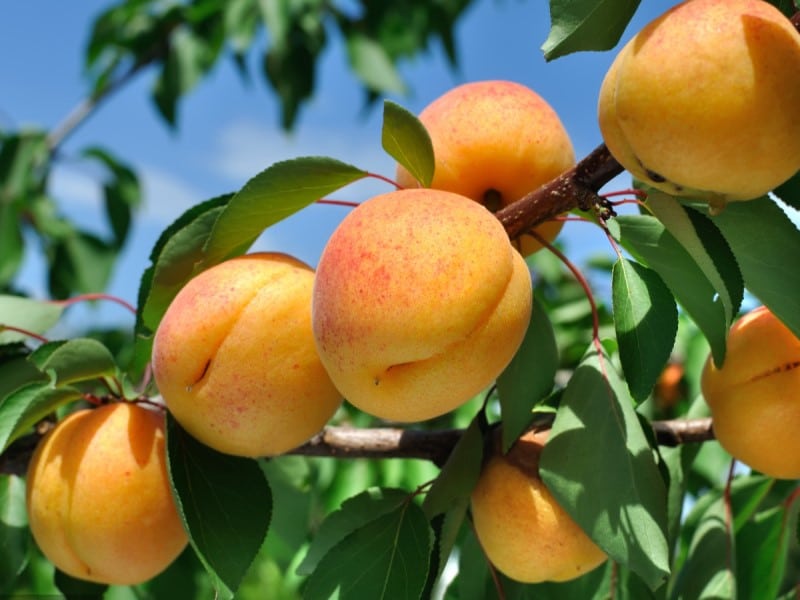
Apricot : Apricot is a fruit (drupes) indehiscent (which does not open spontaneously, at the time of the maturity) of the common apricot, arbre family of Rosaceae, (botanical name: Prunus armeniaca).
Etymology: The word passed from Latin to French via ancient Greek, Arabic and Catalan. The Romans called it praecoquum, i.e. “early (the) fruit”. The Greeks borrowed it from the Romans in the form πραικόκιον (praikókion). The Arabs borrowed it from the Greeks in the form al-barwaq since there is no /p/ sound in Arabic, it has been replaced by /b/, which is the closest sound). The Catalans borrowed it from the Arabs in the form albercoc by adding the definite article to the noun. The word passed into French sixteenth century. ʾAl-barwaq designates today, in the Maghreb, the plum, while the apricot is called mech mech, a word of Persian origin. In Armenian the apricot is called tsiran since the dawn of time.
This fruit is rounded in shape, yellow-orange, with skin velvety. The chair, tender and little juicy, East sweet et perfumed. The core, smooth, peels off easily; I'almond that it contains, edible, is used for perfume the jams of apricot.
History: The apricot tree is a relatively small fruit tree, living in the wild from Iran to Manchuria. In China where it grew wild, it has been cultivated for 4000 years. It passed through India, then Persia and Armenia (hence its Latin name of Prunus armeniaca). orchards are devoted to it in temperate and Mediterranean climates. It is the fruits and their kernels that are used for medicinal, dietary or magical practices. The texts of Egypt and Babylon, the Bible, make no mention of the apricot. According to Pliny the Elder, the apricot tree originated in Mongolia from where Chinese caravans brought it to the kingdom of the Parthians on the shores of the Caspian Sea. There, it would have become the emblematic tree of Armenia and would have spread to Europe, hence its scientific species name: “armeniaca”. Its cultivation spread from Armenia to Greece, then to Italy around the middle of the XNUMXst century AD. Romans and Arabs then took it with them as conquerors. Its fruit is a symbol of the female sex. It is said that Eudoxia, Empress of the East, scandalized the Byzantine Church by her luxury and debauchery; when she exiled the patriarch John Chrysostom from Constantinople, the people besieged his palace and bombarded it… with apricots. At the Court of France, the rebus, already fashionable throughout the Renaissance, became a real mania during the reign of Henry III: "mignons" and duchesses competed in spirit to introduce the word apricot for the purposes of marivaudage. often in rather dubious taste. Finally the Queen got angry and banned the use of the name of this fruit. Countless recipes for charms or potions include apricot pulp or essence to arouse amorous passion.
Nowadays, the first apricots marketed in France and in northern Europe around mid-March come from Tunisia, Italy, Spain or Greece; those produced in France are later. Especially rich in carotene (provitamin A), but also in mineral salts (Potassium, magnesium, calcium, phosphorus, fer, sodium, fluoride), the apricot contains easily assimilated sugars.
Phenolic composition: Fresh apricot contains phenolic compounds which contribute to its antioxidant activity. There are mainly phenolic acids (caffeic, ferulic and p-coumaric acids and chlorogenic acids) and flavonoids.
– The apricot contains phenolic acids (11,34 mg/100 fresh matter) in a much lower quantity than in plums or sweet cherries. Chlorogenic acids have antioxidant and anxiolytic activity (in high doses).
– Raw apricots contain flavanols (or catechins) like cherries. They also contain oligomers of these compounds, called "condensed tannins" or "proanthocyanidol" but in relatively moderate amounts compared to plums. These molecules have a vasodilator activity (by activation of nitric oxide synthase eNOS).
– Anthocyanosides are natural pigments responsible for the red-purple color of fruits. For the apricot, its color also results from the participation of carotenoids (beta-carotene, phytofluene and phytoene). The orange color imparted by beta-carotene is masked by anthocyanosides in red cultivars. The non-sunny side of the apricot turns from green to red during ripening in conjunction with chlorophyll degradation and anthocyanoside accumulation. Three pigments were detected in the skin: cyanidol 3-O-rutoside predominates (75% of anthocyanosides), cyanidol 2-O-glucoside and peonidol 3-O-rutoside (see the data in the table below where the two-year averages and two cultivars are given). These compounds may be present or absent in the flesh depending on the cultivar.
– Flavonols (quercetol and kaempferol) and their glycosides are secondary plant metabolites. Quercetol is an anti-inflammatory and an excellent antioxidant.
World production: Turkey is the main producer of apricots. France is the second largest producer of apricots in the European Union. In 2012, French production was 166 tonnes compared to 900 tonnes for the whole of Europe, ie a share of 514%. At European level, France finds itself, in tonnage, after Italy and ahead of Spain and Greece. The harvest begins in June and continues until August with peak production at the end of June. The first variety harvested is Early Blush, followed by Orangered, Jumbocot-Goldrich and then Tomcot.
World production is dominated by Turkey, and more particularly the Malatya region, with around 695 tonnes of apricots produced in 300, followed by Iran with 2009 tonnes. Most of the Turkish production is intended for drying.
Production in tonnes – 2016 figures:
Turkey: 695.365
Iran: 397.749
Uzbekistan: 290.000
Italy: 233.600
Algeria: 202.805
Pakistan: 193.836
France: 190.382
Morocco: 122.798
Data from FAOSTAT
Characteristics of the main French varieties of apricots
| Variety | Origin | Era | Aspect | Consistency | Flavor |
|---|---|---|---|---|---|
| Berperon | Ardeche, Drome | end of July - mid-August | large, elongated, one red face, the other orange | solid | juicy and sweet |
| early blush | South of France Rhone Alpes | late May early June | all shades orange | solid | excellent fragrant |
| Jumbocot or goldrich | Gard | late June early July | very large, orange | very firm | acidic |
| Orange from Provence | Bouche-de-Rhone Gard, Vaucluse | late July early August | large, orange, variegated with red | solid | tangy |
| orangered | Gard, Drome | end of June | large coppery orange with often red face | medium firm | good |
| Roussillon red | Eastern Pyrenees | end of june mid july | medium orange punctuated with red | with a firm tendency | delicious |
Uses of apricot: We eat fresh apricots. It must be bought just in time because, once picked, it no longer ripens. If you put it in water, you have to dry it carefully to appreciate all its qualities.
Because it is very fragile, the apricot is often quickly canned (apricots au naturel or au syrup, whole or in halves, called " mumps – or even diced in salads).
It is also eaten but also dried (dried apricot) or prepared in various ways: compote, jam, pies, apricots with syrup (canned), as well as in savory dishes, such as rabbit with apricots and parsnip, an English recipe.
It is widely used in the kitchen, in pastry (hot and cold desserts, various cakes such as pies, fruit salads, refreshing ice) and in confectionery (candied fruits, marmalades, jams). Blended into a puree or grout, the apricot integrates with refreshing ice and sorbets.
The apricot is also eaten in nectars, prepared with apricot puree (around 50%), water and sugar. Apricot nectar, erroneously called apricot juice, can sometimes be cut lightly with peach nectar to sweeten the natural tartness of the apricot.
In some countries, such as Pakistan, the kernel located in the kernel of the apricot is also consumed. However, it should be noted that it contains a small amount ofhydrocyanic acid (or hydrogen cyanide). Concretely, the ingestion of a few kernels of apricot kernel is without danger, but the fact of eating several dozen poses a fatal risk.
In the varieties marketed in Western countries, this almond is consumed in oil (apricot oil) and is part of the composition of persipan in northern Europe (unlike marzipan, in which there are Almonds) and the famous biscuit Amaretti biscuits in Italy.
An apricot eau-de-vie is produced in the center of Valais: it is called abricotine. The most famous comes from a very old variety, Luizet, planted in 1868 by Gabriel Luizet.
In Hungary, the pálinka can be prepared with apricots, under the name of barack.
Finally, apricot is a nappage pastry blond. It is a liquid jelly made from jelly finely sifted apricot.
« Apricot " a baba or an pie with fruits gives a nice shine but also serves as protection. This topping protects the fruits from oxidation and drying out.
Quotation from the French writer Michel Houellebecq: "Apricot producers in Roussillon would no longer have a chance, the protection offered by theAOP "red apricot from Roussillon" was only a derisory farce, the surge of Argentine apricots was inevitable, we could already consider the producers of apricots from Roussillon as virtually dead, there would not be a single one left , not even a survivor to count the corpses. » in serotonin (2019, Flammarion Editions).
See as well Apricot under Mouth slang.