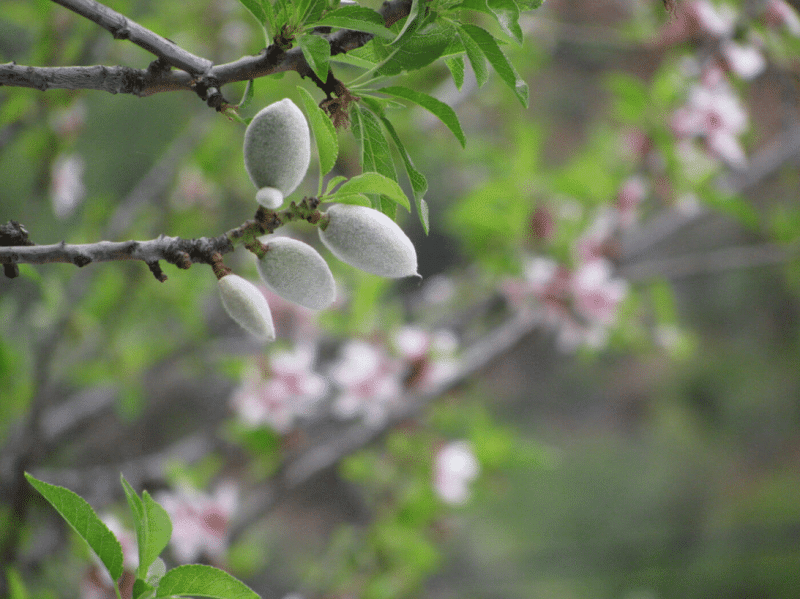
Bitter Almond : Almond bitter is a variant of'common almond (or sweet almond). The bitter almond is from the family of Rosaceae (as the Apple tree, poirier or to fish). Botanical name: Prunus amygdalus var. amara.
She has a taste de core enough pronounced. Bitter almonds come from the almond tree savage. Eaten raw dried, they have a very bitter taste, hence their name. Because they containhydrocyanic acid. In large quantities, it is toxic because of this hydrocyanic acid. We can getoil bitter almond, consumable, after distillation des substances toxiques.
It can thus be used in pastry. The bitter almond is slightly smaller than the sweet almond, with a shell ? tough. It must be distilled so that the substances dangerous may disappear. Then, it is consumable without danger.
Rich in protein (about 20%, almost as much as meat); re-mineralising, with high levels of calcium, magnesium, phosphorus, fer, Potassium, manganese, copper and zinc. Bitter almond is a rich source of Vitamin E, strongly antioxidant and vitamins B1, B2, B3 et B9 ( folic acid). It contains between 11 and 15% of fibers, essentially insoluble, promoting good intestinal transit and giving a lasting sensation of satiety. Also contains Fatty acids (50% of lipids in total) of excellent quality: 35%monounsaturated fatty acids in the form ofoleic acid (as'olive oil), whose protective properties for the cardiovascular system no longer need to be proven (decrease in LDL-cholesterol levels), and 11% ofessential polyunsaturated fatty acids, Of type linoleic acid (omega 6). It also contains phytosterols, which are also beneficial for cardiovascular health.
Uses of bitter almond: Bitter almond is used in pastry, to vary from sweet almond.
Distilled, it conserve long and trouble-free. Distilled, it can also be served as drink Type digestive.