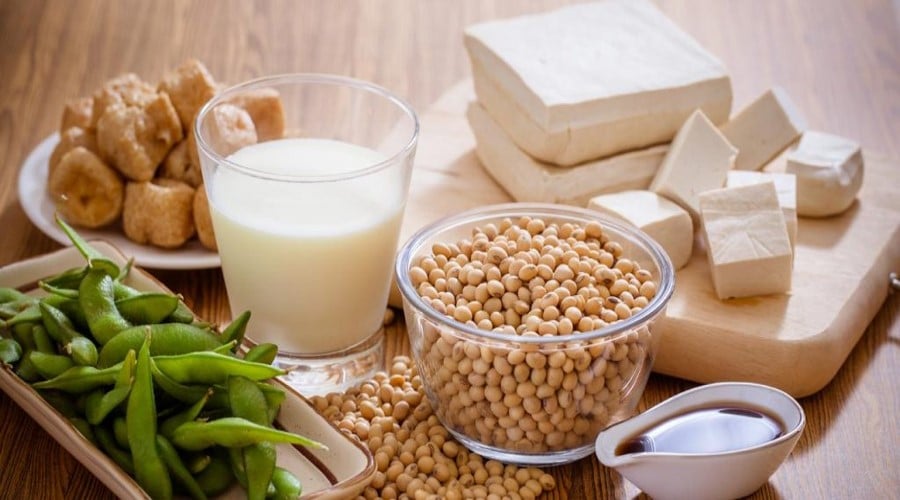
Soy milk : Soy milk, a drink made from soybean (Chinese: 豆漿; pinyin: dòujiāng; Korean: 두유 (duyu); tonyu (豆乳, tōnyū); Vietnamese: sữa đậu nành) is a drink produced from seeds de soybean and water. Similar in appearance to milk de cow and similar in composition on several points, it is commonly called "soy milk" in French-speaking countries and often used as a substitute for milk de cow in thediet and cooking, in particular vegan. In Asia, its consumption is traditional and relatively common.
Le tofu comes from the transformation of tonyu using nigari (preparation based on magnesium chloride and from sea water).
History: Soy milk was probably invented in the early Han dynasty (−202–9).
Composition: Soy milk is prepared industrially from seeds that are soaked, peeled, crushed, mixed with water, then cooked. The whole thing is homogenized then packaged in a sterile manner. Technically, it is a stable colloidal suspension. The fine composition of soy milks depends on the manufacturer, as the product is not standardized. Some manufacturers add a little sugar (cane sugar, or sugar concentrate). fruit juice), a thickener, possibly a vanilla flavor to mask the vegetable taste not appreciated by some consumers.
Soy milk naturally contains few calcium. Commercially sold soy milk can be supplemented with calcium at a level of 120 mg/100 ml, giving it the same content as the milk de cow.
Soy milk contains less saturated fat than cow's milk and is free of trans fatty acids, thus becoming more favorable for people at risk of cardiovascular problems. It also contains, like all soy-derived products, flavonoids, recognized for their virtues antioxidant.
Soy – and therefore soy milk – contains phyto-SERMs, better known as phytoestrogens. Controversies have arisen over the positive or negative influence that this product can have on menopause and on the sexual development of little boys. The content of soy milk in these phytoestrogens, in the form of isoflavones, is on average 7 mg per 100 g. But the variability of the concentration of isoflavones is very high, some soy milks can contain 100 times more than others.
In most countries, prevention regarding soy-based infant products does not exist, with research providing no evidence to support the dangerousness of soy-based formulas.
The presence of pesticide residues and the existence of soy GM are also debated, but there are so-called “organic” soy milks obtained from non-genetically modified soybeans.
| Soy milk composition and comparison with semi-skimmed cow’s milk (per 100ml) |
||
| Components | Soy milk | Cow milk |
| positive | 154kJ (37kcal) | 188 kJ (45 kcal) |
| water | 85 gr | 90 g |
| Proteins | 3,8 g | 3,2 g |
| Lipids | 2,1 g | 1,5 g |
| Carbohydrates | 0,45 g | 4,8 g |
| Lactose | 0 | 4,5-5 g |
| Calcium | 25 mg | 120 mg |
| Magnesium | 25 mg | 11 mg |
| Potassium | 118 mg | 140 mg |
| Iron | 0,64 mg | 0,028 mg |
Name: The name “soy milk” is the most common in French and many other languages. However, European Union legislation specifies that the name “ milk » can only be used in a commercial context for dairy products with a few exceptions (coconut milk, almond milk) which do not concern soya.
Since 2016, theAFNOR highlights the name “ jus de soybean » and defines a standard for producers. However, the term “juice” in French designates a liquid extracted from a plant substance; while soy milk is not extracted from the seed de soybean, which, dry, does not contain liquid, but produced by grinding and dispersing this seed in water. We also use the name “soy drink” for product labeling.
Consumption: In China, it is mainly, but not only, consumed in Breakfast, hot et nature lovers, accompanied byeggs hard, kept and some vegetables pickled.
In Taiwan and Hong Kong, it is more frequently accompanied by beignets Type you uncle.
Substitution for milk of animal origin: Soy milk is the vegetable milk that shares the most properties with animal milks used in cooking (cow, goat, …), and can therefore replace it in the majority of cooking recipes. In particular, it curdles in the presence of a coagulating agent (vinaigre, niggers), it foams and rises when it is boiled, it forms a film, it dilutes the powders well, it ferments, if coagulated serves as a substrate for lactobacilli lactic et ferments fungal type penicillium candidum et Geotrichum candidum (used to make Camembert), etc.
Just like animal milks, it can in no way replace breastmilk for infants: soy milk is, among other things, too rich in proteins and too low in carbohydrates, but above all does not contain the necessary nutrients (mineral salts, vitamins). Thus, an infant died of malnutrition in Belgium in 2017 after being fed exclusively vegetable milk, without any link to veganism since the parents were vegetarians and suspected (without having carried out tests) their baby of an allergy to vegan food. lactose and gluten.
Since both animal and plant-based milks are not suitable for infants, only infant formulas (baby formulas) should be specially used for this purpose, whether they are plant-based (rice, soybean, …) or animal (cow, ...)
Buy your different soy milks here at the best price on the market: