

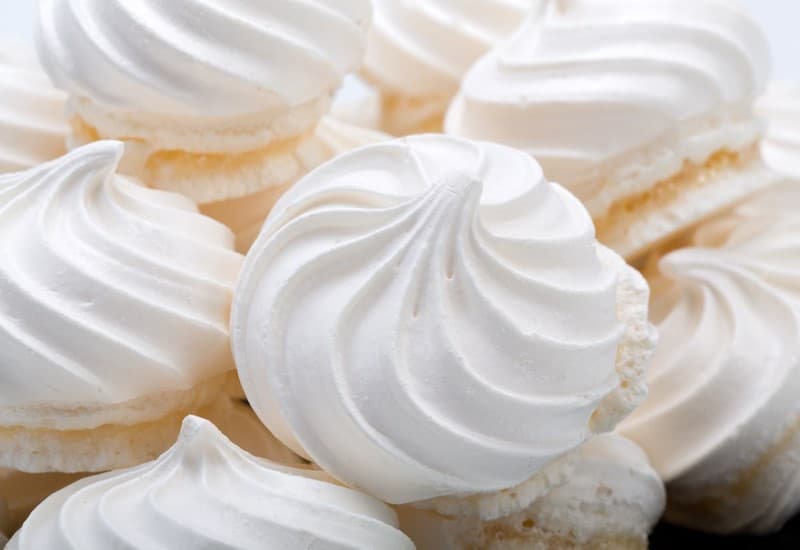
Meringue (pastry) : The meringue is a apparatus de pastry, made of Egg whites firmly beaten in snow and twice the amount of sucre, very light, sparkling, soft ou crisp depending on how cooked it is. Until the beginning of the XNUMXth century, meringues cooked in four molded to the spoon ; it is Lent who had the idea of putting them to bed sleeve pocket.
Preparation of the meringue: The meringue uses the capacity of the egg white to enclose air bubbles in a protein network (proliferation). The dose of sugar is approximately 40-100 g per egg white assuming a white with an average weight of 30 g and knowing that a white can only dissolve up to 50 g of sugar.
L’étymologie de du against « meringue » : On découvre une recette de « biscuits powdered sugar", in the "Pasticier" of Varenne, but the name "meringue" appears in 1692 in the cookbook of Francois Massialot. According to Alain Rey, the origin of the word is controversial:
The origin of the word "meringue" itself is not known with certainty:
– The Polish origin murzynka, “negress”, which would have originally designated a “chocolate meringue”, is unlikely.
– The German Meringel hypothesis, defended for a moment, must be rejected because it is established that it is Meringel that comes from Meringue.
– The Latin sector, meringa, a term from Low Latin and an altered form of merenda, "evening snack", which would have transited through Dutch, must be viewed with caution because of the absence of any attestation of "meringue" in the picard.
– Neither Alain Rey nor the Oxford English Dictionary mentions as a possible origin Meiringen (pronounced “Meringuè” in Swiss German), a village in the Aare valley upstream of Lake Brienz, in German-speaking Switzerland, where Gasparini, the confectioner Italian of the XNUMXth century, excelled in his art.
So it would be this confectioner Italian Gasparini who, around 1600, would have created à Meiringen, a common Swiss du canton of Bern, located in the administrative district ofInterlaken-Oberhasli and who would have given the name of this commune to this dessert à basis de sucre and Egg whites beaten in snow.
We can always us this more smoothly. , Frutal bakery à Meiringen here make different kinds de meringues.
In German, a meringue is called Baiser (except in Switzerland). The Swiss Luxemburgerli were originally called "kisses of mousse ».
The chemistry of meringue: During preparation, beating egg whites breaks certain hydrogen bonds by mechanical shear. This is called protein denaturation. The point of acid sometimes added acts in the same direction. The proteins then have a structure allowing them to trap air bubbles in the mass. The difficulty is not to beat more than the time necessary to obtain a very firm batter. Beyond that, the dough can fall back because the ovalbumin passes into a third phase unable to retain the bubbles. Once this phase is reached, it is no longer possible to go back and make them rise again because it is the protein structure itself that has changed.
The slightest drop of lipid material inhibits the formation of the alveolar structure so that, when separating the yolks and egg whites, a single drop of yolk – which is a lipid – reduces the “assembly” capacity by half. . It is also for this reason that if any flavoring is done in the form of lipid concentrate, it is only carried out just at the end of beating. Plastic bowls are often not recommended because they can, by affinity, retain some traces of fat on the surface even after washing.
The cold helps the "dough" hold well, which is why the beating is sometimes done by placing the container in a " bath " ice.
Sugar is essential to the good behavior of the meringue. It is in fact not possible to make meringues with the most common sweeteners.
Above 100°C, sugar and proteins interact to initiate a Maillard reaction and gives the finished product an appearance ranging from dull gray to amber.
Egg white and sugar are two fairly hygroscopic materials, which is why for conservation it is essential to protect the finished product from all humidity by placing it in an airtight box and a dry room.
There are three different ways of preparing meringue that lend themselves to different uses: Ordinary meringue or French meringue, Swiss meringue and Italian meringue.
Some culinary preparations based on meringue:
Buy here and at the best price your delicious meringues: