

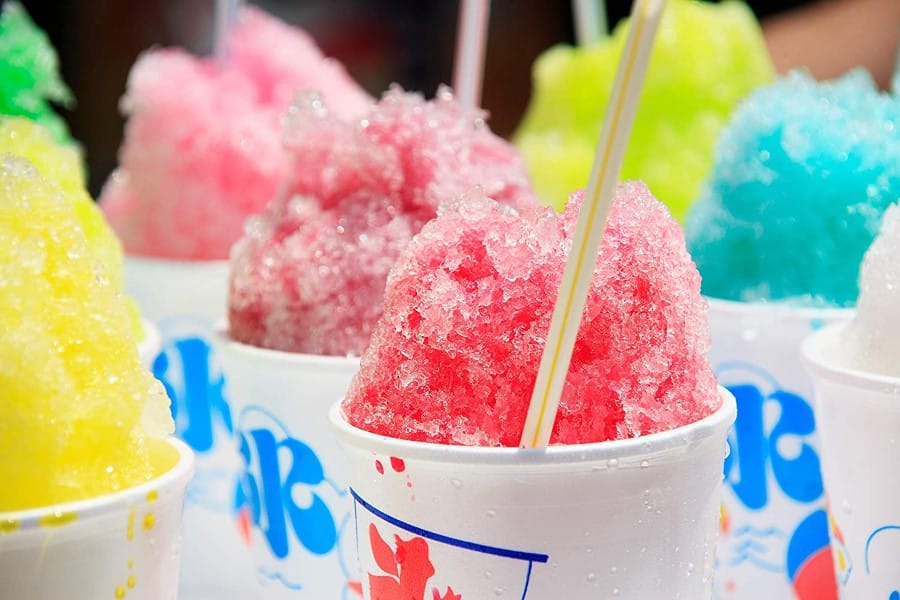
Kakigōri (Japanese cuisine) : Kakigōri (かき氷) is a dessert Japanese à basis de crushed ice flavored with some syrup and sweetener, often from concentrated milk.
History: The origins of kakigōri date back to the Heian period (*) of thehistory Japanese, when blocks de ice preserved during the month most cold were Battery et service with some syrup sugar to the aristocracy Japanese during'summer. The origin of Kakigōri is alluded to in The Pillow Book, a book of observations written by Sei Shōnagon, who served the Imperial Court during the Heian period (*).
Kakigōri became more accessible in the 19th century, when the ice has become more widely available to the public during thesummer. It is thought that the premier kakigōri opened in Yokohama in 1869. The 25 July is known as kakigōri day in Japan because of its pronunciation similar , ice bysummer in Japanese. Another reason why the 25 July and the your of kakigōri is that on that day in 1933 there was a temperature records at Japan
(*) The Heian period is one of the 14 traditional subdivisions of Japanese history. This period, preceded by the Nara period, begins in 794 and ends in 1185 with the Kamakura period. The old capital, Nara, was abandoned in favor of the creation of Heian-kyō, the future Kyoto.
Description: The method traditional de manufacturing kakigōri uses another machine crank to make turn un pad de ice on a paralytic à pounding. Even if the drumsticks Power are most often used, we can still see sellers of street (street food) pound as blocks de ice by hand en summer.
Rather than the ice flavored, the Kakigōri is traditionally made of ice pure, in many cases, being a pad frozen frommineral water. The ice used is often extracted de sources Naturalthen temperate to get a quality ideal for the pounding. Before the arrival of the refrigeration, the caves of montains or coolers were there way traditional de store la ice kakigōri.
It looks like a cone de SNOW but with some differences notable : he has one consistency de ice much more fresh et mellow, a bit like SNOW freshly fallen from ciel, and an spoon is almost always used to eat it. It's here texture of the ice here distinguishes other people's kakigōri types de desserts , crushed ice.
Because of this difference de texture, it has also been translated into English as "Angel Snow, literally: SNOW d'ange", which perhaps seems more attractive.
flavors most Popular are strawberry, The cerise, lemon, Green tea, raisin, melon, the " Blue Hawaii ", the plums fresh and syrup colorless. Some stores offer Varieties colorful en using two people syrups or more. To sweeten the kakigōri, concentrated milk ou evaporated is often versed above.
In addition to street stalls (street food), kakigōri is sold in festivals, garages, cafes, the kakigōri parlors specialized and restaurants. It is also frequently prepare by families , house. During the hot month bysummer, kakigōri is sold almost everywhere in Japan. Especially during festivals et trade fairs bysummer such as the matsuri (**) and o bon odori (***) festivals, often service to sides others foodstuffs of street (street food) such as the yakisoba, takoyaki and cotton candy.
(**) Matsuri (祭り/祭) are traditional Japanese folk festivals and celebrations that take place in almost every locality. Most of them are linked to a religious celebration, most often Shinto. You can play, eat, drink or buy local specialties in stalls (called yatai).
(***) O bon odori (お盆) or simply Bon (盆, without the honorific prefix) or Ura bon is a Japanese Buddhist festival honoring the spirits of ancestors. O bon has existed for more than five hundred years and was imported from China where it is called "ghost festival". Over the years, this religious holiday has turned into a family reunion during which people from the big cities return to their hometowns and tend to the graves of their ancestors.
The Kakigōri is one of the characteristics summer au Japan. Some stores le serve with some ice and Team Red beans sweets or tapioca pearls.
A banner with the kanji sign for kōri (氷) ice cream is a process running et traditional for establishment to indicate that it serves kakigōri.
The Shirokuma (白熊 or しろくま), is a type of kakigōri. The Shirokuma is compound de crushed ice flavored au concentrated milk, small mochi colorful, fruit and dough de beans sweet (usually from adzuki bean). The tangerines
cherries
ananas and raisins are often used to make shirokuma.
The Shirokuma is popular à Kagoshima since environment of the period Edo (****) and he is fine known many Japanese. Of concentrated milk, fruits and dough de beans sweet are service on some crushed ice. He is consommé about cafes and in some department stores, such as Yamakataya (山形屋) or Mujaki.
Etymology: Shirokuma literally means "white bear" and therefore means "polar bear" in Japanese.
There are a few different views on theorigin of this name.
(****) The Edo period (江戸時代, Edo jidai) or Tokugawa period (徳川時代, Tokugawa jidai) is the traditional subdivision of the history of Japan which begins around 1600, with the seizure of power by Tokugawa Ieyasu during the Battle of Sekigahara, and ends around 1868 with the Meiji Restoration. It is dominated by the Tokugawa shogunate of which Edo (former name of Tokyo) is the capital.
In one story, there was a de cotton in the city de Kagoshima. The started selling kakigōri as a side business. The kakigōri was flavored au concentrated milk. When the owner thought of a name, he noticed that the image of a polar bear was printed on the Labels of the box de concentrated milk.
Another account is that Mujaki, a café of the city de Kagoshima, started selling kakigōri, putting syrup de milk, from sanshoku-kanten (gelatin colored) Of the yokan (jelly de adzuki bean sweet), beans sweet and fruit in a pattern that like to a polar bear seen from above top, so it was named shirokuma.
Yet others say he was crestar in thehonor from the memory of Saigo Takamori after his battle with the Edo Shogun.
À Kagoshima, some kakigōri named kiguma similar are manufactured. The kiguma flavored au Sugar Syrup immense refined Brown dark, or syrup de café or caramel and the kiguma flavored au syrup de pulp de mango are also manufactured in some cafes.
Availability: The supermarkets du South de Kyushu en Private in the city de Kagoshima, And stores de candy sell shirokuma as a patented popular. The Shirokuma are often consumed at fairs Kagoshima held in other prefectures of the Japan.
The Shirokuma in cups or bowls are sold at gas stations across the Japan.
Ujikintoki: Ujikintoki (宇治金時 or うじきんとき) is a type from Kakigōri compound de crushed ice, syrup de Green tea flavored, dough de beans sweet (azuki bean) Of mochi and ice cream au Green tea matcha (抹茶アイスクリーム, Matcha aisu kurīmu).
Etymology: Ujikintoki takes its name from the looking city byUji, in the prefecture of Kyoto, famous for its Green tea and Sakata Kintoki, more known as Kintarō in the Folklore Japanese. Kintoki is from dough de Red beans which bears the name of the face of Kintarō (*) generally represented in Red.
(*) Kintarō, which is translated as "golden boy", is a hero of Japanese folklore. A child of superhuman strength, he was raised by an ogress on the Mount Ashigara.
Other experience Varieties :
Yakigori: The Yakigori (焼き氷) is a type of Kakigōri where liqueur, often from brandy, East paid on the dessus and blaze. The Yakigori sometimes has caramel sauce, ice cream, strawberries or ananas on the dessus.
Related Articles:
Bingsu : crushed ice Korean
Halo-halo : crushed ice Filipino (derivative du kakigōri Japanese)
Are you camped et Is tele : crushed ice Indonesian
Namkhaeng sai et O-aew : crushed ice thai
gratachecca : crushed ice Italian popular à Rome.
Crushed ice Hawaiian
Tshuah-ping : crushed ice Taiwanese