

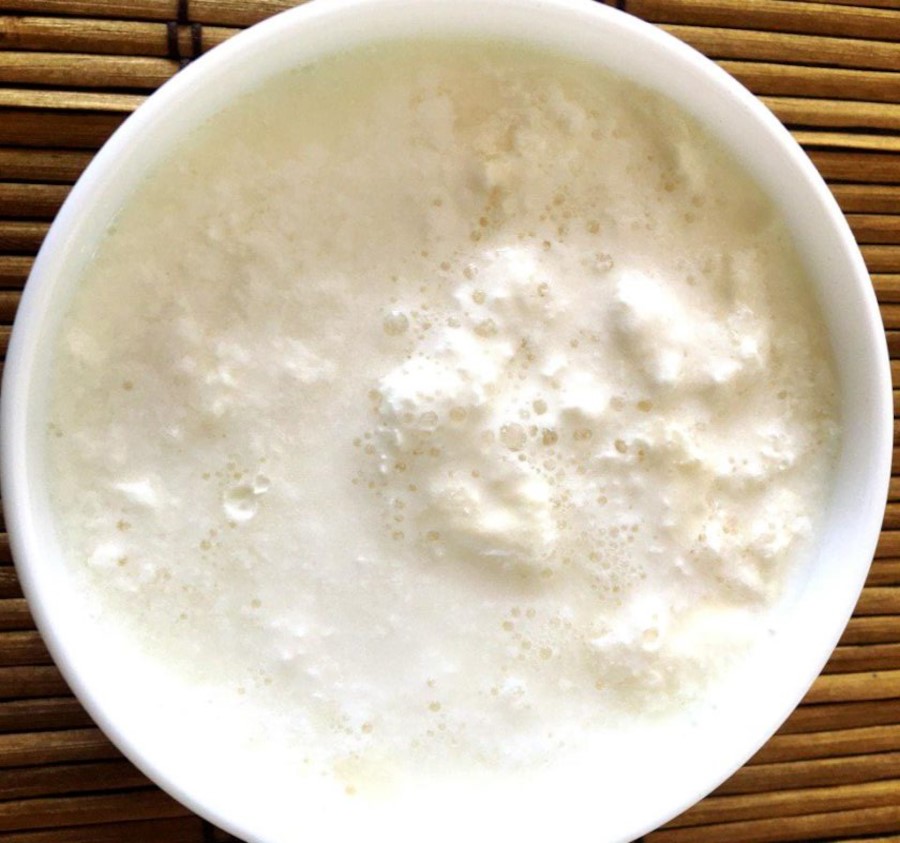
Buttermilk : Buttermilk (sometimes called buttermilk) or buttermilk is a white liquid, with a sour taste, traditionally obtained from fresh or fermented milk after the manufacture of butter by churning; it is also made directly from fresh milk by adding ferments.
This digestible food is used as a drink and is involved in the preparation of various dishes, on all continents. It can be eaten raw or cooked.
Buttermilk is also the stick that is used to beat the butter in the churn.
Buttermilk, as a product derived from cream of milk, comes from the derogatory particle “ba” and the word “butter”.
As a stick powered to beat cream and form butter, buttermilk comes from "beat" and "butter"; this word is also written “bat-beurre”.
Buttermilk is also called "whipped milk", "butter milk" or "churned milk" and even "whey". The Dictionary of Natural Sciences asserts, in fact, in the XNUMXth century, "When the cream has been beaten to bring together the fatty parts which form the butter, a liquor is separated from it, composed almost entirely of milk serum, known as name of whey, and some buttery and caseous parts. ". Émile Littré uses this definition.
Although the expression "whey" is synonymous, in the XNUMXst century, with whey (see diagram below), it is sometimes still used for buttermilk.
Other names are used regionally: guinse » among the Ch’tis, « drunk » in Walloon of Liège, « betteuze in the Vosges, “lait ribot” in Brittany (for churned milk as well as for fermented milk), etc.
buttermilk English, buttermilk german and botermelk Dutch literally take up the notion of “buttermilk”.
Churning of milk by shaking it in a bottle: you can see clumps of butter in the buttermilk.
In Western countries, buttermilk is extracted from freshly milked milk or, more often, from creamed milk by churning. This operation destabilizes the emulsion that constituted the cream, creating the agglomerate of the fatty globules of the milk, which forms the butter, and a liquid made up of the serum of the cream and the debris of the membrane of the globules. This buttermilk retains a complex lipid concentration of 1 mg/l.
Buttermilk can also be made from butter oil; in this case, it has a higher concentration of complex lipids.
Like milk, buttermilk can be made into a powder that contains 4 to 12% fat, one-third of which is phospholipids and other polar fats. In a cool and dry place, this powder can be kept for 6 months.
In the 1990s, buttermilk was also created by adding a bacterial culture to milk. The qualification of “artificial” buttermilk disappeared in the XNUMXst century; English speakers, however, use the denomination of cultured buttermilk to differentiate the buttermilk obtained by inoculating milk from that produced by the traditional process of churning.
In Africa and Asia, it comes from yoghurt. In countries where the temperature is high and where refrigeration infrastructure is lacking, milk is often stored acidified or curdled; buttermilk and butter therefore come from acidified milk and coagulated buttermilk can be transformed into lean cheese and whey.
In India, for example, butter, made from boiled, warmed, and seeded milk, is left to cool overnight to become yoghurt; the next day, we add water to the yogurt (more or less depending on the ambient temperature) and churn it to obtain butter and buttermilk; we keep a small quantity of the latter for the inoculation of the milk which will become yogurt and butter the following day. The sour taste of buttermilk results mainly from the presence of lactic acid naturally produced by the fermentation of lactose, the main sugar in milk. When lactic acid is produced by bacteria, the pH decreases and casein, the main protein in milk, coagulates, making the liquid thicker than fresh milk. It is this acidity which restricts the possibilities of development of potentially harmful micro-organisms and gives a good shelf life to the product.
Buttermilk is lower in fat and calories than regular milk. It is rich in potassium, vitamin B12 and calcium which the body easily absorbs because buttermilk is digested more easily than milk.
The buttermilk powder comprises (in g/100 g): water: 2.8-3.8; lipids: 3-6 proteins: 33-36; carbohydrates: 47-49; ashes and mineral salts: 7-8.
Raw, buttermilk is consumed as a drink, either plain (to accompany kalakukko or buckwheat pancakes, for example), or flavored (notably with grenadine, as in Brittany and Wallonia). It is also used in the preparation of various dishes (the pie at the Maton de Grammont, Binche waffles, Boxty Irish, the traditional Buttermilk Pie from the South of the United States, koldskål and kammerjunker (Danish cookies), etc.). It is a natural emulsifier used in bakery, pastry and ice cream making. It is ideal for preparing fresh sauces with the addition of aromatic herbs and lemon juice. The Wakhis use it as a binder for floury dishes.
Indians and Wakhis sometimes filter it. The filtrate obtained is used by the first "reheated with spices like a vegetable, or used as a cosmetic on the body and hair". The latter add a little water to this tchka to be able to dip the bread in it, or let it thicken to form balls which, when dried, constitute the tchkakryt added to food; they also use buttermilk to moisten the cakes of bread before baking them against the sides of the hearth, which gives them a nice white appearance.
Buttermilk can also be cooked giving it a creamy or pasty consistency depending on the degree of cooking.
Creamy and sweet with brown sugar, it is a traditional recipe popular in Belgium and northern France.
Pasty, it is formed by the Wakhis (people of Afghanistan) into balls which dry on the roofs or on stones to become queryt.
Everywhere buttermilk has proved to be an important food:
In Europe, the use of buttermilk is very common in places where a lot of butter is made; in Holland, for this reason, it becomes a common food, and so esteemed that servants only engage on the condition that it be given to them once or twice a week. It is sometimes used to make soup; it is still eaten in other forms, with the addition of molasses and different ingredients”. It also moistens the bran which is fed to farmyard poultry and cattle.
Buttermilk is used as a crop in the production of feta, White cheese, sheep cheese; it can act as an inoculation product for coagulation with the acid used for the manufacture of fresh cheese. Gaperon is made from it in Auvergne and sarasson, a smooth cheese cited by Olivier de Serres in 1600, in Forez and Vivarais.
In India, butter-making is both economically and ceremonially fundamental, and home-made buttermilk is distributed and drunk in the morning, or taken to the fields unfiltered. Buttermilk therefore has a food but also social importance through its daily renewal and its distribution; it sometimes constitutes remuneration in kind for the “untouchables”.
– Citation de l’écrivain américain John Fante (1909-1983) : « Je bois, avidement, mais bientôt mon gosier se contracte et je m’étrangle ; je n’en reviens pas du goût horrible, c’est le genre de lait dont j’ai horreur, c’est du babeurre. » dans le roman Ask the dust (1939)