

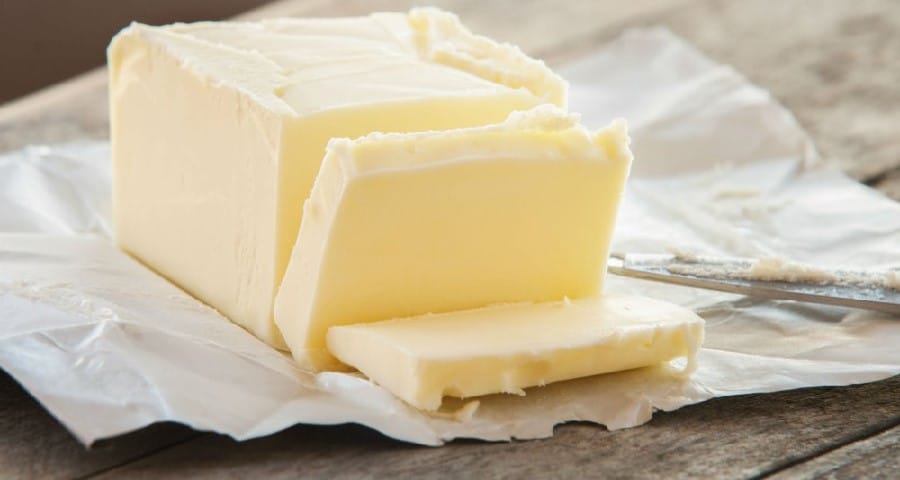
Butter : Butter is a substance oily (82% of fat) obtained by churning of cream du milk, then washed and kneaded to make it smooth. Butter cures au cold and this liquefies , heat. Her color varies from White cream au Yellow gold, depending on the diet of the cows dairy (rich in carotene in grasslands). Nowadays, in France, there is also butter of sheep and goat.
– History of butter: Butter appeared around -4500 years BC, when the cows. Butter had a major role around – 3300 BC, since it allowed our ancestors to keep their foodstuffs in it clarifying.
It was the Scythians, (group of nomadic peoples of Indo-European origin, who lived between the XNUMXth and XNUMXrd centuries BC) who introduced it to the Greeks. The latter, like later the Romans, however, considered it above all as a remedy (healing, in particular) and mainly consumedoil. The Gauls made butter, as did the Germans.
In the Middle Ages, the farm and artisanal production of butter had become common practice. Large clods, sometimes wrapped in leaves bysorrel or greenery, were sold in the markets and then stored in you can de Stoneware, covered withwater salt.
The reputation of Charentes butter dates back to the 1880s. This region, originally dedicated to the cultivation of vine, was ravaged by the phylloxera, and some enterprising farmers decided to replace the vineyards with grasslands. The quality of Charentais butter became as renowned as that of Normandy butter. At that time, the grands crus in Charentes were Saint-Varent, Échiré and Surgères (whose taste of “violet” was praised) and, in Normandy, Isigny, Gournay, Sainte-Mère-Eglise, Neufchâtel-en-Bray and Valognes . Today, Charentes-Poitou, Isigny, Charentes and Deux-Sèvres butters benefit from AOC.
The practice of animal husbandry cattle explains the geographical distribution of butter in Europe. Much appreciated in the Scandinavian countries, in Germany, in England and in France, it is gradually being replaced by theoil (or by the lard or by the fat bygoose) as one descends to the south.
It should be noted, however, that the use of the smen or seed (see this word) in North African countries, which is a derivative of buttermilk From milk de sheep.
– Dietary: Butter has all the properties nutritional of fat dairy.
– Consumed raw, it is particularly digest due to its high content of Fatty acids short and medium chain; on the other hand, it does not tolerate prolonged heating well. It participates in the construction of the brain in children.
It is rich in vitamin A : a daily ration of 20 g covers 20% of an adult's needs.
It is rich in vitamin D : a daily ration of 25 g covers 10% of an adult's needs.
– It is also rich in cholesterol and brings saturated fats.
He is no more gras that margarines (82% of fat) and 92 less than theoil (1%).
- Butter lightened and light butter can only tolerate mild heat; their use is therefore not recommended in pastry.
On specialties dairy products, or "false butter" (20 to 40% fat) should not be heated.
– Butter and other products. In Europe, butter is almost exclusively made with milk de cow ; in Africa and Asia, it is prepared with the milk of buffalo, camel, goat, yak, sheep, Mare ordonkey.
The food industry has also developed substitute products, including margarines, But also bregott Swedish (cream and vegetable oil) and butterine, Australian margarine, (butter and vegetable oil). But, legally, butter is a “ dairy product Type emulsion bywater in the fat, obtained by physical processes and whose constituents are of animal origin”.
Manufacture and conservation of butter: On average, 20 liters of milk to make a kilo of butter. To go from milk to butter a transformation process of 7 steps is necessary:
1) to pasteurization : this is an important step since it eliminates the microorganisms and other bacteria. For this, the milk is heated for 15 seconds at 72°C.
2) ALDI Italy, ecommerce is still farskimming : it consists in separating the milk of his cream by exerting a centrifugal force using a cream separator. It is this cream that will be used to make the butter.
3) to maturation : the butter is compact, the cream not. This is why during this phase we must add to the cream some lactic ferments selected so that theapparatus s'thicken and load in aroma.
4) The churning : this is a delicate and important step. It consists in strongly mixing the cream using a churn so as to form small yellow seeds floating in the milk (we call this the buttermilk).
5) The cleaning : it simply consists in rinsing these "yellow seeds" with clear water to remove the residues. We use a strainer or a fine sieve.
6) The mixing : this is the last step in the production of butter. It is similar to churning but its role is to obtain a smooth and homogeneous mixture by mixing it.
7) The molding : Then simply pour the butter into a butter mold or set it aside unmolded in a butter port covered with parchment paper and a lid.
At room temperature, a good butter should be neither brittle nor lumpy, nor sticky. His aroma is delicate, said "of hazelnut " or "we hazelnut ».
There is salted butter: from 0,5 to 3% salt for the salted butter, more than 3% for salted butter. The unsalted butter has a minimum salt content.
The packaging of the butter is very variable: lumps of butter sometimes farmer, detailed on request; mottillons, baskets or bassets of 1 kg; rolls or slabs of 500 g, 250 g or 125 g; mini individual doses from 7 to 30 g.
The packaging is done in parchment paper, under a aluminum foil lined, which protects it well from the light, or in box de plastic material.
Butter keeps very well fridge : however, it must be placed in a special compartment or in a butter dish hermetic, because it is very permeable to odors. In the past, it was kept in a special butter dish in Stoneware filled withwater salt.
It keeps well in a aluminum foil.
Excerpt from the poem Au Cabaret-Vert by the French poet Arthur Rimbaud (1854-1891):
“A week ago, I had torn my boots
On the pebbles of the paths. I entered Charleroi
- At Cabaret-Vert : I asked for toast
Butter and ham that was half cold”.
Related Articles:
- Bresse butter
- Charentes-Poitou butter
- Échiré butter
- Isigny butter
Check White butter ; Nantes butter ; Red butter ; Compound butter ; Bresse butter ; Charentes-Poitou butter ; Isigny butter ; Roasting butter ; Seaweed butter ; Clarified butter ; SLIGHTLY SALTED butter.
See also under Mouth slang: Butter ; Butter ; Buttered ; Butter.
Culinary uses of butter : Cost et raw, the butter tartine on toast, canapés et sandwiches ; he accompanies the delicatessen
sea food and cheese. It is then presented in small butter dishes individual.
Cut with a knife shellfish (or frieze-beurre) or in small washers, it is used with meat and fish grilled
vegetables "English style", pasta and rice. It allows to prepare compound butters.
He is above all a ingredient base of the Food. Fat body used for pans
stir-fried
roasted, even the braised, it is however more delicate to use as theoil or lard, Because he burns more easily, except butter baking (see Clarified butter et Roasting butter). For cooking, it is often used mixed withedible oil to reduce the smoke point.
It captures and fixes the flavors. It is essential for Sauces emulsified hot (as the béarnaise or Dutch) Et les roux, also for butter many soups and soupes and perform the bonds. It is the basis of pastry (qualified as "pure butter" when it does not use any other fat), especially for buns, croissants, shortbread, cookie dough, puff pastry et cabbage dough, cakes dry et mochas, pies, as well as for butter creams et pastry creams which serve as fodder.
Clarified ou molten, it serves to butter many Musselsor a brush or to water various preparations. It also intervenes in confectionery for the making of chocolate truffles, fudge, caramel, butter apple et lemon curd.
Tips for using butter: They must be respected to keep the butter's culinary qualities.
A very cold butter, grated in shavings, blends better with dough to darken.
Butter sugar, For pastryis conserve even better than the salted butter (The knead with 20 to 25% of granulated sugar). A butter that sizzle will not splatter if you have first applied salt in the stove.
The different butters in cooking:
- mania butter : lightly buttered softened et mixture with some all-purpose flour for Liaison.
– softened butter: butter softened up to one consistency by ointment.
- clarified butter : le clarified butter is a butter molten et decanted
impurities and whey remain at the bottom of the pan.
– compound butters: many compound butters are butters addedor a cold or to hot,aromates and various ingredients.
– fried butter: butter passed throughEnglish and free. We obtain a melted butter contained in the shell of breadcrumbs solidified.
- White butter : sauce obtained by emulsion hot on reduction byéchalotes, vinaigre de White wine.
– Nantes butter: white white whose vinegar has been replaced by White wine (Muscadet) and stabilized , double cream.
– orange butter: white white added de Orange juice (Or other citrus). It is mainly served with fish and shellfish.
- peanut butter : blond butter which takes on a reddish tint at the baking.
– black butter: preparation tricky because when it reaches its smoke point, i.e. approximately 120°C, butter producesacrolein, a substance toxic and indigestible. The employment of black butter is now banned. The Italians use the name black burro which is in fact a peanut butter.
– roasting butter: Le butter for roasting current is a clarified butter with a content of water and protein very weak. It therefore withstands very high temperatures (up to 180°C) and is ideal for making to roast several foodstuffs.
“We didn't have any butter or bacon, so Jane would cook the pancakes with nothing. And it wasn't pancake batter. Only flour with float. It came out crisp. Really crunchy ”. (Charles Bukowski inFactotum).