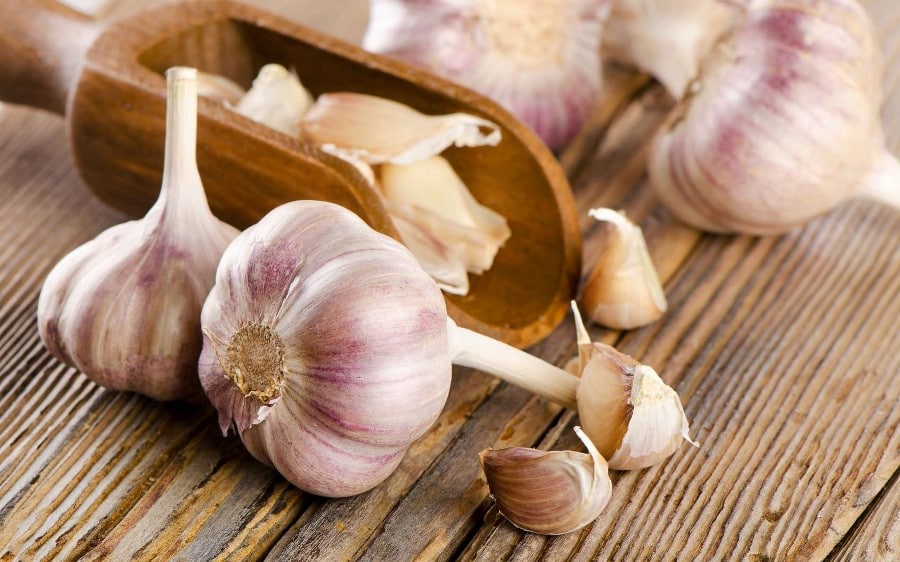
Common garlic : Garlic common or garlic or cultivated garlic (Family of Liliaceae - Botanical name: Allium sativum) is a species of plants vegetable garden lively monocotyledon whose bulbs, To the Odour and taste - and flavor spicy, are often used as condiments en Food.
A head of garlic consists of several cloves ou pods garlic.
Garlic has been known since ancient times for its medicinal properties.
Hippocrates classified garlic among the sudorific drugs, ensuring that it was “warm, laxative and diuretic”.
Thanks to the crusaders, it was considered the panacea in Europe, even against the plague and demonic possessions (The heads of garlic waved before the vampires or Dracula...).
One of the most popular medieval sauces was “garlic sauce”, which combined crushed garlic with parsley and sorrel, to accompany fish, or with vinegar and bread crumbs, for grilled meats. .
Description of garlic: Plant herbaceous, bulbous and fairly large perennial with numerous leaves sheathing the bottom of the stem. It measures 5 to 12 cm in height.
The inflorescence is rare in many cultivars and only appears occasionally under stress. It is wrapped in a one-piece spathe that falls quite quickly. The flowers are grouped in umbels. Quite few in number, they are white or pink in color and bloom in summer.
The fruit is a capsule with 3 compartments, but this is very rarely produced and the floral scape more often gives rise to floral bulbils except for cultivars originating from Central Asia and the Caucasus which are close to the wild type.
Vegetative propagation is rather the rule through the bulbs formed at the base of the stem. These are bulbs composed of 3 to 20 arched bulbils (pods) called cloves. Each is surrounded by a parchment tunic and the group of the same foot is itself included in an identical tunic with multiple layers.
Subspecies and varieties: The traditional classification distinguishes cultivars according to morpho-physiological criteria based on their vegetation period and the color of the tunic of the bulb and bulbils.
– Autumn garlic is planted from September to November, it is white or purple garlic which is often earlier but tolerates the cold less well. It very rarely produces flower stalks. The harvest is spread over two months from mid-April to mid-June for the fresh harvest and from mid-May to mid-July for the dry harvest. It keeps until December-January.
– Spring garlic is planted between December and January with a month more or less depending on the varieties and the climate and sometimes even until March. It also very rarely produces flower stems. It is pink garlic which is almost always harvested dry in July. It is kept until March-April of the following year.
– Stick garlic is called alternative because it can be planted from November to February. It commonly produces flower stalks. These are pink garlics generally harvested dry from mid-June to mid-July.
Each of the groups has its own cultivars, largely grown in regions of southern Europe.
Currently nearly 130 cultivars are listed in the European Catalog of Species and Varieties and nearly 35 in the Official French Catalogue.
In the case of France, depending on the region where they are grown and their specific color, these varieties are sometimes labeled:
– White garlic from Lomagne (Midi-Pyrénées), IGP
– Auvergne garlic
– Garlic from Cherrueix (Brittany).
– Drôme garlic, IGP
– Garlic from Provence
– Smoked garlic from Arleux (Nord-Pas-de-Calais, PGI application pending);
- Lautrec pink garlic (Midi-Pyrénées), IGP and Label rouge
– Pink garlic from Var (synonyms: Rose de Brignoles or Moulinen)
– Purple garlic from Cadours (Midi-Pyrénées)
Based on isozymes, a recent scientific classification delimits several varietal groups and subgroups.
Botanical variety Allium sativum var. sativum. The first two groups have the same enzymatic profile.
– Group I: Mediterranean, flower stem, 2 fertile leaves. Average dormancy. Mainly present in Spain but also found in France, Italy, Croatia, Algeria. Also a variety present in Senegal and Niger and a clone known in Indonesia. Called No. IV, Colorados, Creole by some authors. Known in France with the type Rose de Lautrec and the clones: 'Goulurose', 'Ibérose', 'Jardirose', 'Morasol', 'Morasur', 'Sultop' all with a pink tunic.
– Group II: temperate or Mediterranean climates with cold winters, no flower stalks, more than 3 fertile leaves. Average dormancy. 10-12 bulbils with a pink or pearly tunic. Enzyme profile IIb. Mainly in Northern Italy; present in many temperate countries and also in West Africa. Called group III, blancos, silverskin by some authors. Present in France with Rosé du Var, Ail du Nord, Rose d'Auvergne and the clones: 'Arno', 'Printanor', 'Cristo', 'Gayant' with pearly tunic and 'Flavor', 'Fructidor', 'Jardinor' ', 'Moulinor' with pink tunic.
– Group III: Mediterranean, no flower stalks, more than 3 fertile leaves. Large bulbils. Quite weak dormancy. 8-12 white tunic bulbils. Enzyme profile IIc. Present in southern Spain, Romania, France, California also in some areas in subtropical Africa. Called blancos, artichoke by some authors. Known in France with the whites of Drôme and Limagne and the purple of Cadours and by the clones: 'Corail', 'Dario', 'Jolimont', 'Messidor', 'Thermidrôme' with white tunic and 'Germidour' with tunic violet.
Tropical subgroup: earlier with varieties from South China and Taiwan.
– Group V: southern Mediterranean or tropical lowland, flower stem sometimes present, 3 fertile leaves. Very low dormancy. Numerous bulbils (20-40) with white or pink tunic included in a white or purple tunic. Enzyme profile IIa. Present in warm areas (South and Eastern Mediterranean up to Yemen, Guinea, West Indies, Reunion, South India, South America. Named No. II, subtropical by certain authors. Represented in France by the variety 'Ramsès'.
“Early Asian” subgroup: flower scape sometimes present, 2 fertile leaves, more pronounced cold requirement. Very low dormancy. Bulbils larger than group IV. Called turban by some authors. Known in France with the clones 'Primor', 'Sprint' all with purple tunic and floral stem.
Botanical variety var. ophioscorodon
– Group IV: continental climate, flower stalks, 2 fertile leaves. Bulbils larger than group I. Enzyme profile III. Present mainly in Eastern Europe. Called rocambole, colorados, ruso, no III by some authors. Includes two different types Rocambole and Continental.
Botanical variety var. pekinense
– Group from North China and Japan: flower stalks, 2 fertile leaves. They can be white or pink, in this case reminiscent of certain cultivars from group I, but keep less well. Enzyme profile IVb.
Botanical variety var. longicuspis (see chapter “Origin”)
– Wild type group: vigorous flower stalks, purple bulbs, 2 fertile leaves. Some authors call them porcelain for the type producing few large bulbils or purple striped for the type producing many small bulbils. Very varied enzymatic profile: Ia, Ib, Ic, Id, IVa, IVb, IVc, IVd, IVe.
– Subtropical varietal group
– Group VI: mountain tropical, flower stem, more than 3 fertile leaves, early, fairly high cold requirement. Bulbils larger than group V and fewer in number (5-10) with purple bulbar tunic. Low dormancy. Enzyme profile Vb, Va. Found in Mexico, Peru, Egypt, Reunion, Madagascar, Thailand, Viet-Nam. Named tropical, n°I by some authors.
Main constituents of garlic:
– Essential oil (diallyl disulfides, allicin (antibiotic), alliin, alliinase, inulin)
– Carbohydrates
– Selenium
– Vitamins A, B, C and E
– Sulfur compounds
The plant gives on average by distillation 0,25% of essential oil (i.e. approximately 7,5 mg per garlic clove of approximately 3 grams, very far from the lethal toxicity threshold of allyl sulphides, which would require the ingestion of nearly 200 cloves of garlic per kilo, or more than 14 cloves of garlic for an adult weighing 000 kilos, which is not feasible). However, in the concentrated form of the distilled essential oil, the product can easily become toxic and highly allergenic, by ingestion of a quantity close to one gram (almost all essential oils, often very active in this form, are toxic and must be handled with care and sparingly, avoiding contact with skin and mucous membranes, direct ingestion and vapors in the eyes). However, allergies can develop over the years through unprotected, repeated and frequent contact with fresh garlic.
Cooking garlic removes most of its allergenic toxicity (but does not make it more digestible for those who have difficulty metabolizing its overly concentrated organosulfur compounds). However, the initial preparation by crushing the fresh garlic clove (easier to do by removing the central germ which is a little too woody, which practically does not reduce the quantity of organosulfur still present in the clove) and leaving garlic puree oxidizing in the air for 15 minutes before consumption (the time for the most active volatile products to be released and the transformation of the released alliins to take place) is generally sufficient to remove its potentially allergenic or digestive intolerances; the relative low toxicity of the natural product is also reduced to zero in an acidic pH below 3 (e.g. in the stomach) and does not represent any special danger (this is not the case for the essential oil by direct contact with the skin and mucous membranes, on which it can cause inflammation, dangerous on the respiratory mucous membranes: the essential oil should not be inhaled directly or only in very low doses and in slow diffusion).
Composition of garlic:
– 64% water
– 27,5% carbohydrates
– 6% protein
– 3% fiber
– Miscellaneous: prostaglandin, acid phenols, phytosteroids, polyphenols, flavonoids…
– Vitamins (mg per 100 g): B1 (0,2), B2 (0,08), B3 (0,65), B5 (0,6), B6 (1,2), C (30), E (0,1), A…
– Minerals (mg per 100 g): Potassium (446), Sulfur (200), Phosphorus
144), Calcium (38), Magnesium (21), Sodium (10), Chlorine (30).
– Trace elements: Iron (1,4), Zinc (1), Manganese (0,46), Boron (0,4), Copper (0,15), Nickel (0,01), Molybdenum (0,07 ), Iodine (0,003), Selenium (7 to 20 ppm).
Origin of garlic: The center of primary diversification is located in Central Asia (Kazakhstan, Tajikistan, Xinjiang) with a secondary branch in the Mediterranean and the Caucasus and another in Afghanistan and northern India. These wild strains have a relatively undiversified morphology that can be described in three groups: the “early Asians” present in the center of the area, group II d in the east and the probably original group with large floral stems and purple bulbs represented by three types, one with few (4-6) and fairly large bulbils, another with more numerous (8-12) and smaller bulbils and a third with very small bulbils (the size of a pea) and even more numerous.
This third group has either male-sterile or male-fertile flower stalks. Some clones produce seeds normally. They are very close morphologically but in fact quite genetically diverse and are grouped under the botanical variety name var. longicuspis.
Diffusion : It has been used for 5 years. Garlic cloves have been found in clay dating back to 000 BC. B.C.
It was widely cultivated in Egypt. Herodotus reports that the first social conflict in human history was caused by the garlic ration withheld from Egyptian workers building the pyramid of Cheops.
The Ebers papyrus mentions garlic in around forty indications. The Greeks and Romans believed it had a strengthening power and fed it to their soldiers in the field. Greek athletes consumed large quantities of it, for its strengthening power (the vasodilation and bronchodilation properties of garlic are indeed of obvious interest in improving sports performance). In the Odyssey, Hermes gives it to Ulysses who uses it as an antidote to avoid being changed into a swine by Circe. In his Ploutos, Aristophanes tells, to make the audience laugh, that garlic could be used by certain masochists.
Garlic cultivation: The plant likes light, deep soils, rich in old nutrients and well drained. The seeds are buried 3-5 cm deep, the plants spaced 10-15 cm apart and the rows 25-30 cm apart. Garlic bulbs rot in heavy, loamy soils, especially if they remain wet. Do not cultivate in organic soils or use fresh manure, this will cause them to rot. Garlic prefers mineral granular fertilizers. Never cover the garlic bulbs, the surface of the bulb must be exposed to the air. Use the outer parts for planting and the center for consumption.
In France, it can be planted from May. In warmer regions, planting can be done until fall if it is done in soil that will drain well in winter. Fall plantings produce better harvests.
In Canada, planting is generally done in October under mulch which is removed in the spring. Some prefer to plant in spring as soon as the ground has thawed. The harvest is done at the end of July, beginning of August.
Harvest: At the end of summer, “tie” the foliage (lay it on the ground) in order to ripen the bulbs and increase the harvest.
Pods from grocery stores are often treated with anti-germinatives and therefore cannot be replanted.
World garlic production:
| Production in tons. Figures 2013-2014 Data from FAOSTAT (FAO) |
|||||
| 2013 | 2014 | ||||
| China | 18 429 500 | 79% | 19 168 800 | 79% | |
| India | 1 228 000 | 5% | 1 259 000 | 5% | |
| South Korea | 339 113 | 1% | 412 250 | 2% | |
| Egypt | 309 155 | 1% | 234 164 | 1% | |
| Russia | 239 312 | 1% | 232 843 | 1% | |
| Bangladesh | 233 609 | 1% | 224 000 | 1% | |
| Burma | 213 000 | 1% | 212 000 | 1% | |
| Ethiopia | 222 548 | 1% | 170 000 | 1% | |
| USA | 195 910 | 1% | 175 445 | 1% | |
| Ukraine | 171 400 | 1% | 185 600 | 1% | |
| Other countries | 1 848 314 | 8% | 1 981 200 | 8% | |
| Monde | 23 429 862 | 100% | 24 255 303 | 100% | |
Protected Geographical Indication : Several crops have received the IGP label for garlic6: pink garlic from Lautrec, grown in the Tarn department, in 1996 (Red label since 1966), white garlic from Lomagne (2008), smoked garlic from Arleux (2010)7 , garlic from Drôme.
Genetics: Despite its great nutritional and therapeutic interest, garlic has been the subject of little research for improvement apart from the very often mass and empirical selection of currently existing cultivars. The observation of cultivars from seeds collected in Central Asia is only just beginning (Japan, United States of America, Europe, Israel) to find varieties that are resistant to diseases or can be reproduced by seeds. A fertile Mexican variety has just been discovered which could lead to an improvement intended for tropical countries.
Intra- or interspecific sexual or somatic hybridization, since it is often sterile, is at the moment very confidential or even non-existent. The only hybridization trials took place with summer leek (Allium ampeloprasum) and onion (Allium cepa) and were carried out solely for the purpose of studying genetic material. There is no commercial hybrid. Its chromosome count is 2n=2x=16. There are no known polyploids.
– Raw pods, whole and peeled: rubbed on pain (“rubbed with garlic”, aillade, capons fried); For perfume the walls of a bowl, skillet, fondue pot.
– Chopped or pounded raw garlic: seasoning for raw vegetables; aioli ; tapenade ; pistou ; garlic butter; mash potatoes garlic.
- In parsley : made of parsley and garlic chopped.
- Garlic raw hurry : oils flavored.
- Garlic dried en powder.
– Pitted shards: leg et shoulder bylamb.
- Garlic minced ou chopped and cooked: stir-fried preparations (fish, meat, frogs, s, tomatoes, champignons, potato, salsify) ; add the garlic at the end of baking, because, too rissole, it makes the preparation acre.
– Whole cooked pods (sometimes with the skin, who are " in shirt ”): stews et braised (cassoulet); roasted : the cloves must be removed before serving; other dishes, on the contrary, are served with garlic cloves cooked with their skin, such as the road.
In soupes as'aîgo boulido Provencal.
– Very finely cut for pasta, like in Sicily, with the old razor blade.
Some culinary preparations based on or with garlic :
- L 'aioli
- the snail butter
- L 'aigo boulido
- the rouille
- the Cheese Fondue
– pasta cu l’agghia (garlic pasta, Sicilian recipe)
– Knoblauchsuppe (Austrian garlic soup)
– Knoblauchbagette (bread rubbed with garlic then baked, Austrian recipe)
- the tourin, garlic soup, specialty of Gascon cuisine.
When cooking garlic, some advise removing the germ, which would be less digestible than the rest of the clove (due to a greater concentration of organosulfur products).
The alet: Garlic or green garlic is a young garlic shoot, approximately 3 months old and 20 cm high, which has not yet formed its cloves and is therefore only found in spring. We use the barrel and the leaves. Cut into thin slices, it is used to flavor salads, green or mixed, and omelettes. Its flavor is quite pronounced and is similar to that of garlic. It can also be used in cooking, in spring dishes, with new vegetables. It freezes well.
Aillet is especially appreciated in France from Poitou-Charentes to Languedoc. For fans, it is an essential ingredient for kid, also available at Easter time.
Tradition around garlic
The “garlic capitals”: In France, many towns and villages readily give themselves the title of “garlic capital”:
– Arleux, in the North, capital of smoked garlic.
– the village of Piolenc is the capital of Provençal garlic (garlic festival, every year on the last weekend of August).
– in the Gers, Saint-Clar is the capital of white garlic, a title also claimed, in the same geographical area, by Beaumont-de-Lomagne (Tarn-et-Garonne).
– in Haute-Garonne, Cadours, the capital of purple garlic.
– in Tarn, Lautrec, capital of pink garlic.
– in Puy-de-Dôme, Billom is the capital of Auvergne garlic.
– in Reunion, Petite-Île is the capital of garlic.
– in the United States, the garlic capital is Gilroy (California).
The famous garlic fairs:
– In Champagne Ardennes, The Givet garlic fair, every November 11.
– In Auvergne, The Billom garlic fair, every mid-August.
– In the north of France, in Arleux, every first Sunday in September.
– In the south, in Uzès: every June 24, garlic fair on the occasion of Saint-Jean.
– In the west, in Cherrueix, end of July.
– In the Tarn, in Lautrec, every first Friday in August
– In Tarn-et-Garonne: Beaumont-de-Lomagne.
– In the Gers: Saint-Clar.
– In Tours (Indre-et-Loire) on Saint Anne’s Day (July) around the market halls.
– In Charente and Charente Maritime, on the morning of May 1st, the custom continues in the villages of gathering to eat the brine of garlic with bread, sausage, cricket and a glass of wine.
At Easter, we also prepare roast leg of kid with garlic.
Check Gastronomic events.
Proverbs and quotes about garlic:
“Eat lots of garlic. It rejuvenates the body and removes unwelcome people. Alexandre Vialatte, French writer.
“The mortar always smells of garlic.” Means that one retains the habits of one's original environment.
“He who has garlic in his garden does not need a doctor.” Because of its medicinal properties.
“For it to work, you need garlic.”
“Garlic is the poor man’s penicillin.”
“Garlic is to scare away wolf dogs” (Agen quote).
See as well " Ail »Under Slang of mouth.