

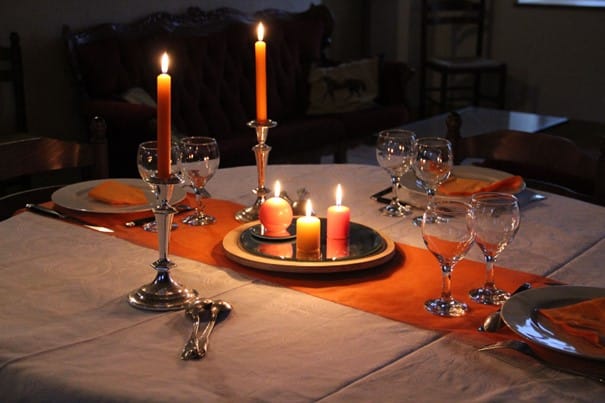
Dinner : nmet verb int. (word coming from the latin popular °disjuncture « to break up le young ").
Dinner is the meal du soir, in the sense modern ; until the end of the Ancien Régime (*), it was the meal du matin or milieu du jour. at theorigin, the word designates the meal du matin, taken after mass, first around 7 a.m., then at 9 or 10 a.m. Often compound de bacon,eggs as well as fish, dinner was one of two great meal of the day, with the Soul taken around 17 hours. In the Middle Ages (**), the medical school of Salerno (Italy) also advocated: "Get up at five, dine at nine, supper at five, go to bed at nine, make you live for ninety-nine years".
(*) The expression "ancient regime society" designates in this article the mode of social organization that prevailed in the kingdom of France from the end of the XNUMXth century to the end of the XNUMXth century.
(**) The Middle Ages is a period in the history of Europe, extending from the end of the XNUMXth century to the end of the XNUMXth century, which begins with the decline of the Western Roman Empire and ends ends with the Renaissance and the Great Discoveries.
Gradually thetime of dinner receded during the day, while the rite of the daily mass was less strictly observed, and henceforth it became the habit of serving a light collation at sunrise (it was the breakfast, which was not yet called " small "). Under Louis XIII and Louis XIV, we dined at midi, as reported by Furetière (***): "When you want to find people, you should do it between eleven hours et midi, especially not later because then we would disturb them to sit down to eat. […] Seek midi when it's only eleven o'clock say to themselves snifflers who come just before dinnertime so that we have to invite. They are also called demons of midi. Or researchers of midi, such as those who sneak into your house at noon with the aim of stealing something when the table is set”.
(***) Antoine Furetière is a French poet, fabulist, novelist and lexicographer (1619-1688) who published in 1690 a Universal Dictionary containing generally all French words, both ancient and modern, and the terms of all sciences and arts.
In the 14th century, dinner was postponed to XNUMX p.m., but the Soul often remained meal principal of the day. Under the Revolution, finally, it took place at the end ofafternoon, while the Soul was served, riding a city, To theoccasion by evening. In the countryside, where habits had changed less, the meal du soir has long continued to be called " Soul ". Today, dinner is around 20 p.m., earlier in the Countries Nordic, later in the Countries mediterranean. Alexandre Dumas defines dinner as a "daily and capital action which can only be accomplished with dignity by people of spirit: for it is not enough at dinner to eat. You must speak with a gaiety serene and discreet, The conversation must sparkle with the rubies of wines bydesserts, she must take a sweetness delicious with sweet things du dessert and acquire a real depth in coffee " keep staying.
In certain regions ., dinner is always meal du soir which takes place mainly in in family or for a occasion carefully precise (dinner of engagement, dinnerbusiness).
Dinners in town are accompanied by an activity or an event: dinner-debate, dinner-colloquium, dinner-concert, dinner-show.
Finally, in some French-speaking countries (Belgium, Canada, Switzerland), the term "dinner" is used for " meal de milieu du jour ».
– Quote from the French journalist, novelist and playwright Alfred Capus (1858-1922): “At certain dinners, if I wasn't there, how bored I would be! ".
– Quote from the American writer Truman Capote (1924-1984): “One evening at a dinner party, he felt Berenice's foot on his own. As she had taken off her shoe, he shuddered in contact with this warm caress” in the novel The crossing of summer published in 2006.
dinner (intransitive verb) :
The verb "dinner" has several meanings:
1. Aged sense or regional : (North of the France ; Canada, Belgium, Switzerland, Congo, Burundi, Rwanda):
Take the meal de midi. Lunch.
– Quote from the French director, screenwriter and writer Alain Guiraudie (born in 1964): “She offers me to stay for dinner, she says “dinner” for lunch (like many old people in the area […])”.
– Quote from the American writer Truman Capote, by his birth name Truman Streckfus Persons (1924-1984): “He didn't do it. So she took the initiative by announcing: 'I'm lucky, I'm not doomed to have dinner alone. Peter Bell is taking me to a restaurant.' in his novel The crossing of summer (published posthumously in 2005).
2. Take the meal evening (Soul).
We have dinner at eight hours.
Proverb: Who sleeps dines.