

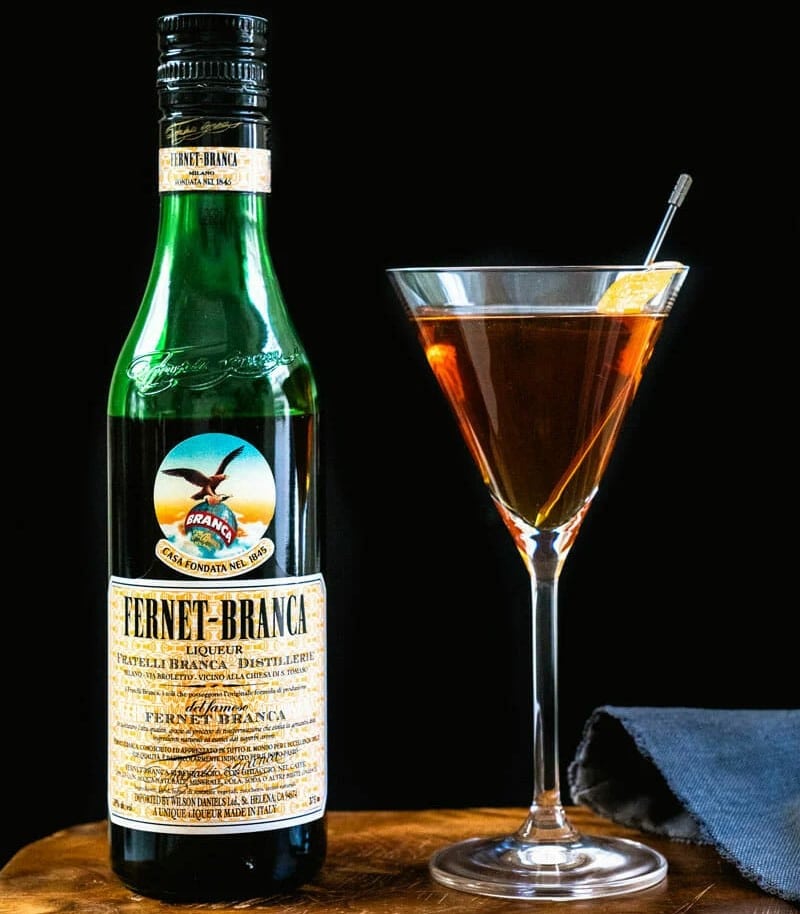
Fernet Branca : The Fernet is a alcoholic drink bitter de type bitter made from different types ofherbs (myrrh, rhubarb, camomile, cardamom, oregano et safran, among others), which are macerated in wine.
La drink is then filtered et left to rest in barrels de Oak for a period of six to twelve months.
The Fernet branca has a color dark, aroma intense and total alcohol content between 39 and 45 degrees, depending on the trademark. Initially, the term fernet was integrated into the trademark Italian Branca then it came into common usage to designate the patented so generic.
Originally it was just a drink digestive, but nowadays it has become a drink versatile which often served in aperitif before or in digestive after a meal. It can also be served with some café and express. Although it may be consommé pure, given its taste and its alcohol content, it is usually drunk in combination with soda, themineral water or mixed in cocktails, especially with coca.
History: Its origin dates back to the XNUMXth century in Europe, and there are different stories about its true birthplace. It is believed to be a variant of Jägermeister, a bitter herbal sweet liqueur containing 35% alcohol. It is made from herbs and is very popular in Lower Saxony in the town of Wolfenbüttel. Some say it was created in France, others in Czech Republic, others still in Austria, thanks to an apothecary named Fernet.
However, most sources place the origin in Italy, Lombardie.
Perhaps the best-known version is that told by one of the oldest production companies of this drink, Fratelli Branca, which still manufactures the product in the city of Milan. This company attributes the invention to the pharmacist Bernardino Branca and his collaborator, a Swedish doctor bearing the name of Fernet, two surnames which will give his name to the liqueur. This company's version contrasts with that of another renowned brand, Ramazzotti, which also continues to produce its drink in the city of Milan. According to the latter, it was Ausano Ramazzotti, the house's founder, who developed his bitter in 1815. The Vittone factory, on the other hand, attributes the invention to Domenico Vittone at Milan in 1822. According to another traditional, the word fernet derives from the Milanese expression fer net (“polished iron”), according to the plate of fer Red originally used for to prepare la liqueur.
En Argentina : The drink was introduced in by Italian immigrants, who consumed it for medicinal purposes. medicinal et digestive. The use of fernet then spread asaperitif, especially with copetínes (*), combined withwater, soda, vermouth red or in cocktails, the most popular drink today being that obtained by mixing fernet with soda flavored with tail, popularized in the late 1980s in the province of Cordoba and colloquially called “Fernet con Coca” (Fernet with Coke) or Fernando.
(*) Copetin: snack Argentinian usually eaten in the afternoon. The copetín has similarities with the dive Spanish.
La consumption de Fernet is today deeply rooted in Argentina : according to Cámara Argentina de Destiladores Licoristas, in 2014, around 51 million liters of “amargos, bíter y Fernet” were produced in the country, showing for the first time a decrease (around 10%) in 25 years of statistics. Of this production, about 35% is consumed in theAMBA (with a population of around 16 million) and 30% in the province of Cordoba (with a population of about 4 million). According to the company White, it is at Cordoba that was born, in the early 1990s, the mixed of Fernet and coca. In this province, this cocktail is now part of the cultural identity. However, this claim about the origin of the drink is rather questionable because, contrary to the company's claims, it can be verified in television commercials from the mid-1980s, broadcast on television channels. Buenos Aires with national coverage, that the company White itself was already using the combination of the two products as a marketing strategy.
The Fernet Branca in the world:
- In Italy, the word fernet refers only to the drink of the Branca brand, but to Italian products such as Martini or Luxardo (*) are exported under this name.
In Italian we use the word bitter (amer) and there are many brands: Fratelli Branca distilleries, situated at Milan, Averna, Lucano, Montenegro, Cynar, Luxardo (*) from Padua, Martini de Turin, Amaro del capo.
(*) Girolamo Luxardo SpA is a factory of liqueurs Italian. Founded at Zadar, she settled in torreglia nearly Padua after 1945.
- In Czech Republic, the “Fernet Stock” exists in two versions, the version Nature and the version at lemon with a light and taste de lemon. In this country, she is consumed en shots, or mixed with ice and tonic, a drink known as “Bavorské Pivo” (Bavarian beer) or “Bavorák”.
- In the town of San Francisco (California), this practice has become very popular in recent years: the Fernet is served in shots, followed by another s de ginger ale.
- At Denmark, it's a drink too popular whether Argentina.
– Le Fernet is very popular au Paraguay, especially in bars from the old center ofAssumption.
– In recent years, it has also become popular en Bolivia, particularly in the department of Tarija and is also marketed at La Paz , Cochabamba, Santa Cruz de la Sierra.
Cocktails : The Fernet can replace the bitters in some recipes; for example, the Fanciulli Cocktail is a Manhattan with Fernet instead of bitter Angostura. The Toronto is another variant du Manhattan made with whiskey, Fernet and bitters.
In the 1920s, Ada Coleman, manager of the bar of'Savoy hotel à London, popularized the Hanky Panky cocktail, made from equal to gin sec Londoner and vermouth, with the addition of some drops of Fernet and a zest byorange. This cocktail recently made a tentative comeback in the cocktail bars French United States of America. Chef Fergus Henderson offers a recipe called "A Miracle", which is similar to Branca-Mint, by combining two parts of Fernet with one part of liqueur de mint and ice. The recipe indicates that this cocktail can be used as remedy French excessively., but does not specify whether it isexcessively. gustatory ou alcoholics.
A variant of the Fernet base flavored au tail consists of adding lemon juice or even to replace the drink at tail by soda flavored au lime, what's more popular in the Fernet version flavored , mint. To Chili, it is used for concoct a cocktail called Terremoto, which is prepare (in addition to Fernet) with pipeño wine and ice withananas. It is also drunk as digestive, associated with liqueur de camomile.
Popularity: Argentinian golfer Ángel Cabrera, who won the US Open in 2007, said in an interview with American media that he liked to drink Fernet with coca. He even admitted to having been kicked out of a restaurant in Italy during an open because the owner found it extremely vulgar that he mixed du tail with Fernet.
Argentinian rock band popular Vilma Palma e Vampiros recorded a song referring to this drink popular on their album Fondo profundo (1994); the song is called Fernet con Coca.
In episode 5 (Suspicion) of season 1 of The Sopranos, the character of Carmela Soprano tells the priest that she had "a little Fernet". The system is established.
There are now new alternatives to established Fernet brands. But they often have other marketing channels, since they are not found on the shelves of large supermarkets, but in regional stores, in the neighborhood grocery store or in neighborhood stores.
Fernet Branca is the subject of a comic number by Bill Cosby of the same name, from the album Fat Albert, in which he describes his own experiences with the drink.
In the series A Bit of Fry and Laurie (Hugh Laurie, the actor who plays Dr. House), in the second episode of the fourth season, he makes a drink that includes Fernet Branca.
The main character of the film Les Nuits de Cabiria, directed by Federico Fellini, consumes du Fernet.
The popular song Asado y Fernet by the band Los Caligaris refers to Fernet and asado as a custom typical Argentinian. In their song Hielo they say “agua que no tienes de beber hacela hielo para el fernet” and there is another song called Oda al fernet.
In the film The Dark Knight Rises (2012), the character Alfred Pennyworth, played by Michael Caine, mentions his fondness for Fernet and is seen ordering a Fernet Branca at a cafe in Florence, Italy.
In the Argentinian series Casi ángeles, one of the main characters is seen using the pseudonym "Valeria Fernet" for the film La Vampiresa.
Official website of Fernet Branca